How Centinel's checking account forecast works under the hood — the inputs, the walk-forward algorithm, the design decisions, and what the outputs mean.
March 15, 2026
Most personal finance tools don't explain how they work. Budgeting apps categorize your spending without disclosing their logic. Bank balance projections don't reveal their assumptions. When a tool produces a number, you're expected to trust it without understanding where it came from.
Checking account cash flow forecasting is different — the methodology is transparent enough to explain in plain language, and understanding it makes the outputs meaningfully more useful. That said, not every forecasting tool approaches this the same way. Some treat cash flow projection as a high-level trajectory view across multiple accounts, while others are built as focused, single-account liquidity engines around principles adapted from corporate treasury management — differences that are evident when comparing tools like Quicken Simplifi and Centinel. This article explains how Centinel's approach works: what goes in, how the engine processes it, and what it produces — including the specific design decisions that make the forecast reliable rather than misleading.
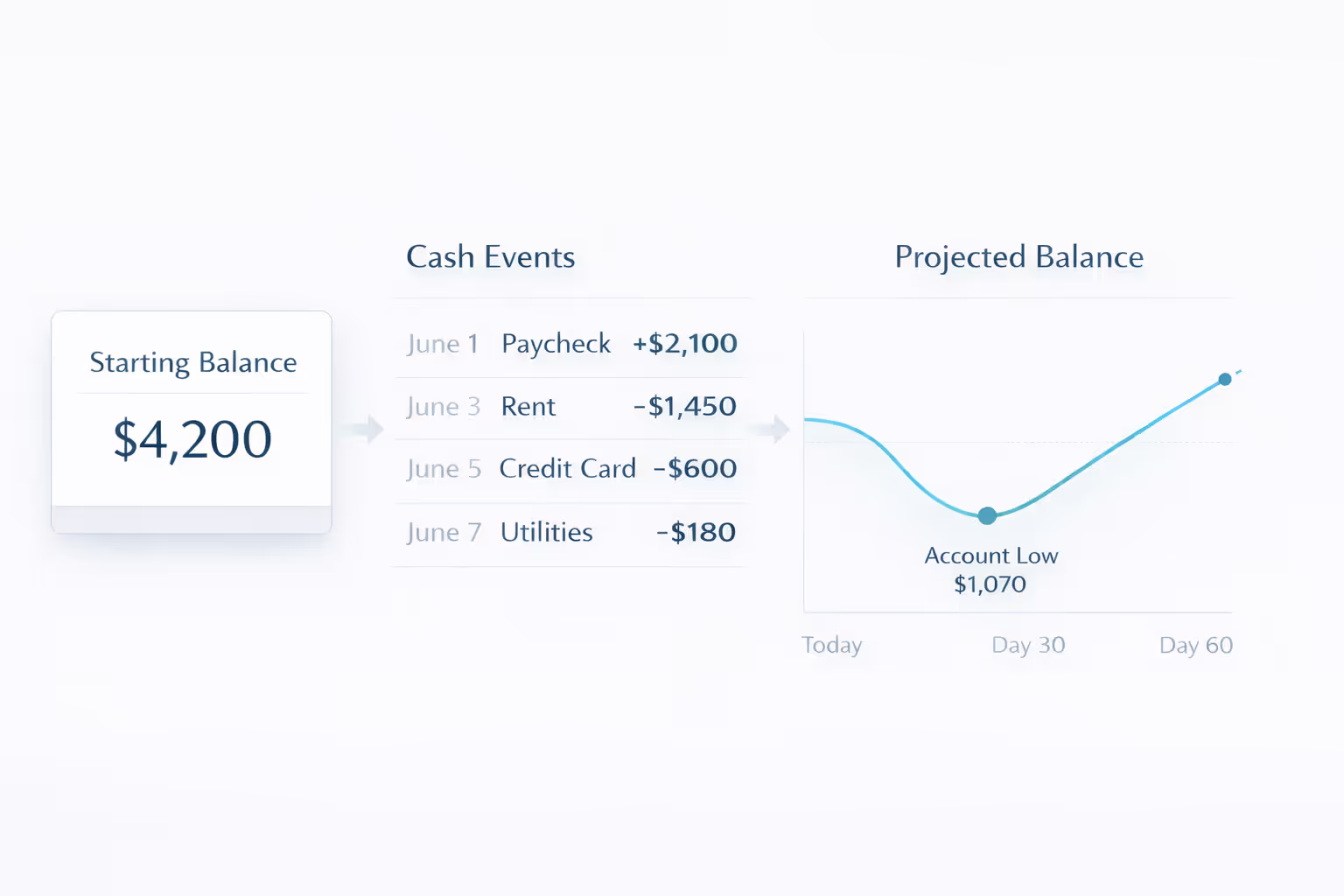
Centinel's forecast has four layers: the inputs (your current balance and your defined cash flow events), the design philosophy (deterministic calculation rather than AI prediction), the engine (a walk-forward algorithm that steps day-by-day through a 60-day window), and the outputs (Account Low, a dual-threshold comparison, and actionable alerts). Everything that follows explains each layer in sequence.
The forecast takes two inputs: a starting balance and a cash flow schedule. These define the raw material the engine works with — and the quality of those inputs determines the quality of everything the forecast produces.
Every forecast starts with a known, real number: your actual checking account balance right now. Not an estimate, not a historical average, not a projection from yesterday's number — the real balance as of today.
This matters more than it might seem. A forecast that starts from an approximate or averaged balance inherits that estimation error across every subsequent day. If the starting balance is off by $200, every projected daily balance in the 60-day window is off by $200 before any other discrepancy is introduced. Starting from the real number eliminates baseline error at the source.
Centinel's Premium tier pulls the real checking balance each day via Plaid and re-anchors the projection to that number automatically. This daily refresh means the walk-forward always starts from where the account actually is today, not where the forecast calculated it should be yesterday. Drift — the gradual divergence between projected and real balances that accumulates when a forecast runs from a stale starting point — is eliminated by design. Centinel's free tier uses the same principle through manual entry: you update your balance yourself, and the forecast recalculates from that real anchor. The mechanism differs; the architectural principle — always start from reality — is the same.
The second input is your complete set of defined cash flow events: every recurring income source, every recurring expense, and any known one-time items. Each event has four attributes: an amount (how much), a direction (income or expense), a date (the anchor date from which recurrence is calculated), and a frequency (the schedule by which it repeats).
Centinel supports nine recurrence frequencies: one-time, daily, weekly, biweekly, semi-monthly, monthly, quarterly, semi-annual, and annual. The full range matters because different cash flow patterns require different scheduling. Supporting the full frequency spectrum means the forecast can represent your actual cash flow pattern rather than forcing everything into a monthly approximation.
Setting up your cash flow schedule requires identifying and entering your recurring events — a process that involves reviewing recent bank statements and mapping each transaction to its recurrence pattern. The most reliable approach is a two-step process: brainstorm from memory, then verify against your bank history to catch what you missed. Centinel's Premium tier reduces much of this friction during onboarding by analyzing your recent transaction history and surfacing recurring patterns for you to confirm — turning what might be an hour of line-by-line review into a few minutes of verifying suggestions and filling in gaps.
Credit card payments in your forecast are a recurring cash flow event like rent or a car payment, but with a key difference as an input: the amount is variable, and it isn't known until your statement closes. On Centinel's free tier, you enter your best estimate for the upcoming payment and update it manually when each statement closes. On the Premium tier, you connect your credit card via Plaid (read-only) and set a payment preference — full statement balance, minimum payment, or a custom fixed amount. From there, Centinel detects each new statement automatically and updates your forecast with the projected payment based on the actual statement data and your preference. The credit card entry in your cash flow schedule becomes a dynamic input that refreshes each billing cycle rather than a static estimate.
In addition to cash flow events, Centinel takes one more input: the Floor. The Floor is the minimum balance you want to maintain in your checking account at all times. It's not a cash flow event — it doesn't add or subtract from projected balances. Its role is in the output layer, where the forecast's projected balance is compared against it to determine whether your checking account is safe or at-risk.
Before explaining how the engine works, it's worth understanding the fundamental design philosophy that governs it. Everything the algorithm does in the next section follows from a single architectural choice: Centinel's forecast is deterministic, not predictive.
This distinction matters. A deterministic forecast calculates projected balances based on the cash flow events you have explicitly defined. A predictive forecast uses machine learning or pattern recognition to infer future transactions from historical spending data. Both approaches produce a projected balance trajectory, but they work from fundamentally different assumptions — and those assumptions have practical consequences for reliability, transparency, and responsiveness.
Deterministic forecasting is the right architecture for short-term checking account cash flow projection for three reasons.
When you update a pay date, adjust a bill amount, or add a new recurring expense, a deterministic forecast recalculates instantly because the engine is working directly from the updated inputs. Predictive models, by contrast, need weeks of new transaction data before they can adjust to a changed pattern. The model's internal weights were trained on the old pattern, and the new pattern has to accumulate enough data points to shift those weights. This means a predictive forecast lags behind reality precisely when your situation is changing — which is exactly when forecast accuracy matters most.
You get a fully functional forecast from Day 1 once you've entered your cash flow events. Predictive models require a cold-start period of accumulated transaction history before they can generate meaningful projections. The tool is therefore least useful when you need it most: right after onboarding, when there's no track record in the system and you're still building familiarity with the product.
You always know exactly what the forecast is based on — the events you've defined. There is no opaque model making inferences you can't inspect or override. If the forecast is wrong, you can identify exactly which input caused the discrepancy and correct it. With a predictive model, a wrong forecast is much harder to diagnose because you can't see what patterns the model inferred or what weights it assigned.
The honest tradeoff is that deterministic forecasting requires more upfront effort. Rather than connecting an account and waiting for a model to learn, you need to identify and enter your recurring events — or, with Centinel's Premium tier, review and confirm the events that Centinel identifies automatically from your transaction history during onboarding. The result is a forecast you can fully understand and trust because every assumption is visible — but that initial setup cost is real and shouldn't be glossed over.
With the inputs defined and the design philosophy established, here's how the engine actually works.
Starting from today's real checking balance, Centinel's algorithm steps forward one day at a time through a 60-day horizon. On each day, it checks whether any scheduled cash flow events fall on that date. Expenses reduce the projected balance by their amount; income increases it. The result is a projected balance for that day, which becomes the starting point for the next day's calculation. Days with no scheduled events carry the previous day's balance forward unchanged.
After 60 iterations, the algorithm has produced a complete day-by-day trajectory of projected balances — one for every day from today through Day 60.
The following table shows the first 14 days of a walk-forward calculation for an individual with a starting balance of $1,900, biweekly pay of $1,750, and a typical set of monthly expenses. Days with no scheduled events are omitted — the balance simply carries forward from the previous day.
Several patterns are visible here. Rent dominates the first of the month, cutting the balance from $1,900 to $500 in a single day. The balance then continues to decline through the early days of the month as smaller expenses post, reaching its lowest pre-paycheck point of $305 on March 7 — just before the paycheck arrives and lifts it to $2,055. Days without events (March 2–4, March 6, March 8–9, March 11, March 13) carry the previous balance forward unchanged. And on March 7, something specific happens that deserves its own explanation: both an expense and a paycheck land on the same day.
On March 7 in the example above, the water bill and the biweekly paycheck are both scheduled. The balance enters the day at $360. In the forecast, the $55 expense posts first, dropping the balance to $305, and then the $1,750 paycheck posts, raising it to $2,055.
This ordering is a deliberate design decision. When income and an expense are both scheduled on the same day, Centinel assumes the expense posts before the income arrives. The projected balance at the low point of that day therefore reflects the outflow having cleared while the inflow hasn't yet.
The rationale is grounded in how banks actually process transactions. In practice, the posting order of transactions varies by transaction type, institution, and timing of submission. Some process debits before credits on the same business day; others use order of receipt. By assuming expenses post first, Centinel errs on the side of caution. If the forecast says the balance won't go below a certain level, that projection holds even in the worst-case posting order scenario. If income actually posts first in reality, the real balance will be better than projected — which is the right direction for the error to go. A forecast that is occasionally too pessimistic is far more useful than one that is occasionally too optimistic, because the consequences of being caught short (overdraft fees, declined transactions) are much worse than the consequences of having slightly more cash on hand than expected.
Centinel uses a 60-day forecast horizon. The length isn't arbitrary — it's calibrated to the cash flow patterns the forecast needs to capture.
A 60-day window captures at least four full biweekly pay cycles. Even in the worst case, where the first paycheck falls on Day 13, subsequent pay dates land on roughly Day 27, Day 41, and Day 55. You see the biweekly rhythm repeat four times, which makes managing the timing mismatch between biweekly pay and monthly bills much more manageable. It also covers most monthly billing cycles twice, so recurring expenses appear more than once and their cumulative impact on the balance trajectory is fully visible. And it includes at least one complete credit card statement-to-payment cycle, which matters for people whose credit card payment is one of their largest monthly outflows.
The 60-day window also provides meaningful lead time. Seeing a projected shortfall three weeks from now gives you substantially more options to act than seeing it three days out. With three weeks of notice, you can adjust discretionary spending, pick up additional work, move money between accounts, or renegotiate a payment date. With three days of notice, most of those options are gone.
Shorter windows miss important dynamics. A 7-day forecast is essentially just a bank balance with a few transactions projected forward. Longer windows introduce a different problem: uncertainty. Life changes — a new job, a moved apartment — make projections beyond two months increasingly speculative without continuous recalibration. The 60-day window occupies the sweet spot where the forecast is long enough to be strategically useful and short enough to remain meaningfully accurate.
The walk-forward algorithm explains how the forecast is built. But a forecast calculated once is only accurate until something changes — a transaction posts a day late, an amount differs from what was scheduled, or an unexpected charge appears. Keeping the forecast accurate is an ongoing practice, not a one-time setup, and it comes down to keeping two things current: your starting balance and the cash flow events.
Centinel's Premium tier addresses this with three interconnected mechanisms. Daily balance refresh re-anchors to the real checking balance each morning via Plaid. Transaction matching compares real bank transactions against scheduled events using a confidence-based, multi-signal scoring algorithm — evaluating amount similarity, date proximity, merchant name, and transaction category — to determine which forecasted event each transaction corresponds to. High-confidence matches resolve silently; ambiguous cases surface for your review. And reconciliation resolves the discrepancies that matching surfaces — both transactions that posted but couldn't be matched and forecasted events that were expected but never appeared — keeping the cash flow schedule itself accurate over time. Together, these three mechanisms prevent forecast drift, the gradual divergence between projected and real balances that degrades forecast reliability. The free tier relies on you performing the same functions manually.
Once the walk-forward is complete, Centinel has a projected balance for each of the 60 days. The algorithm scans all 60 values and identifies the single lowest point. This is Account Low — the projected minimum balance over the entire forecast window.
Account Low is the most important number the forecast produces because it represents the bottleneck day: the single point in the next 60 days when the checking account is under maximum pressure. Every other day in the window has a higher projected balance. If the account can get through the bottleneck day, it can get through every day.
Because every daily balance in the walk-forward was calculated using the conservative same-day timing assumption described above, Account Low is itself a conservative figure. It reflects the lowest projected balance under worst-case same-day posting order — not the average-case or optimistic-case outcome.
Account Low is a number. It becomes actionable when compared against thresholds that represent meaningful risk levels. Centinel compares Account Low against two thresholds, producing two possible forecast states.
The first threshold is $0. If Account Low is projected to go below zero, the account is projected to overdraft — meaning actual fees, declined transactions, and the cascading consequences that make overdraft fees so costly.
The second threshold is the Floor. The Floor serves a dual purpose. It's the warning threshold that defines when the forecast is at-risk, potentially triggering before overdraft territory is reached. And it's the optimization threshold that defines how much is safe to deploy when the forecast is safe — because everything above the Floor on your most constrained day is, by definition, not needed to cover your obligations or maintain your comfort level. If Account Low is projected to fall below the Floor but stay above $0, you aren't going to overdraft, but you're going to be more exposed than you want to be — and you have advance notice to act.
Account Low ≥ Floor: Your balance is projected to stay at or above your minimum comfort level at all times. In this state, Centinel surfaces Available Cash: Account Low minus Floor. This represents the amount you could confidently move out of checking — to savings, investments, or debt paydown — without ever dipping below their Floor, even on your most constrained day. It also represents the answer to the question most people are actually asking when they check their balance: not "how much is in my account?" but "how much of this is genuinely safe to spend?"
Account Low < Floor, or Account Low < $0: Your balance is projected to dip below your comfort zone — or below zero. This state raises an immediate question: when does the problem occur, and how much is needed to fix it? Centinel answers that question with two metrics — First and Total Needed.
Account Low tells you the worst point in the balance trajectory, but it doesn't tell you the first point. These can be — and often are — different days. That distinction matters because the most urgent problem and the most severe problem may require different responses on different timelines.
To illustrate, consider someone with a $2,100 starting balance and $1,750 biweekly pay whose forecast shows two separate overdraft events — one shallow, one deep — separated by six weeks:
Centinel surfaces two metrics from this trajectory.
First is the date and amount of the earliest projected overdraft: March 3, $150 below $0. This is the most time-sensitive signal because it defines how much lead time you actually have. If today is February 24th, you have seven days to address the first problem.
Total Needed is the amount required to cure all overdrafts across the entire 60-day window: $540 — the depth of Account Low below $0. Here's why that single number works: the walk-forward is a connected, day-by-day calculation, so depositing $540 into the account today raises every projected balance uniformly by $540. Account Low on April 16 goes from −$540 to exactly $0 — the overdraft is eliminated. The March 3 shortfall goes from −$150 to $390 — well above zero. One deposit, sized to the worst point, cures every overdraft in the window.
The distinction between First and Total Needed prevents two common mistakes. The first is underreacting — ignoring the March 3 overdraft because it's smaller than the total shortfall and assuming the bigger number is the only one that matters. The March 3 overdraft will trigger real fees in seven days regardless of what happens in April. The second is overreacting — scrambling to produce $540 immediately when the most urgent need is $150 and there are six weeks to plan for the remaining $390. Understanding which problem is first and which is worst lets you respond deliberately rather than reactively. You might triage — address the $150 immediate shortfall now and build toward the remaining $390 with the lead time the forecast has given you. Or you might deposit the full $540 today and cure every projected overdraft in the window with a single transfer. Either way, you're making the decision with complete information about what's urgent, what's severe, and how much time you have — rather than guessing.
This is the kind of forward-looking, time-aware risk analysis that distinguishes a cash flow forecast from a static balance check. A balance check tells you where you are. The forecast tells you where you're going, when you'll get into trouble, and exactly how much trouble you'll be in.
A forecast that surfaces risk only when you open the app leaves value on the table. The point of identifying a future shortfall is to act on it before it arrives — and that requires the information reaching you proactively rather than waiting for them to come looking.
Centinel's Premium tier translates the forecast outputs into push notifications. When the forecast detects that Account Low has crossed below the Floor or below $0, Centinel sends a notification containing three pieces of information: the current forecast status (at-risk), the date(s) in question (when the shortfall(s) is projected to occur), and the shortfall amount. Not a vague "balance is getting low" message — a specific, forward-looking warning that names when the problem will occur and how short the account is projected to be.
This is a fundamentally different approach from standard bank low-balance alerts. A bank alert fires after the balance has already dropped below a threshold. It reports a problem that has already happened. By the time you read the notification, the overdraft fee may already be assessed and/or the transaction may already be declined. Centinel's alerts fire when the forecast crosses a threshold — meaning the problem is projected to happen days or weeks from now, with enough lead time to prevent it entirely. This is the difference between overdraft protection and overdraft prevention: one catches you after you fall, the other shows you the edge before you reach it.
Forecasting only helps if you trust it, and trust requires understanding. This article exists so that anyone evaluating Centinel's methodology can see exactly how it works — the inputs, the design philosophy, the engine, and the outputs — and judge for themselves whether the approach is sound.
The principles described here are not proprietary. They are adapted from decades of corporate treasury practice and made accessible to individuals rather than Fortune 500 finance teams. What Centinel adds is the automation layer — daily balance refresh, transaction matching, Plaid connectivity, proactive alerts — that makes this level of rigor practical for a consumer checking account without requiring a full-time analyst.
Centinel is currently accepting early access signups.
STAY A STEP AHEAD