Learn what Account Low is, how it's calculated, and what your projected minimum balance reveals about your checking account's future cash flow and available funds.
January 2, 2026

Your checking account shows a balance of $3,200 right now. But what does that number actually tell you? It confirms you have money today, but it says nothing about whether you'll have enough to cover your bills next week, whether you're at risk of overdrafting in two weeks, or how much of that balance you can confidently spend or deploy to investments, debt paydown, or savings without creating problems down the road.
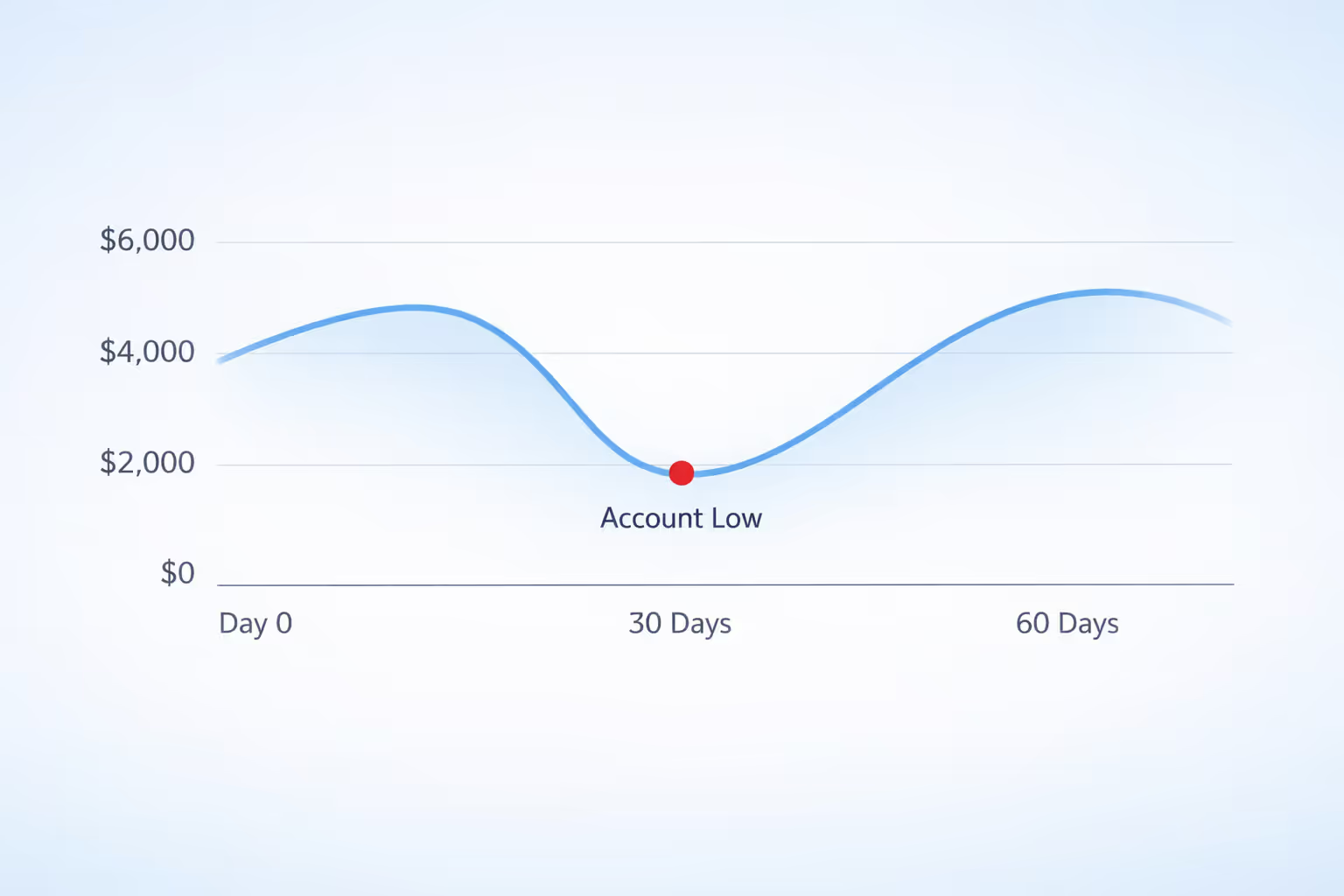
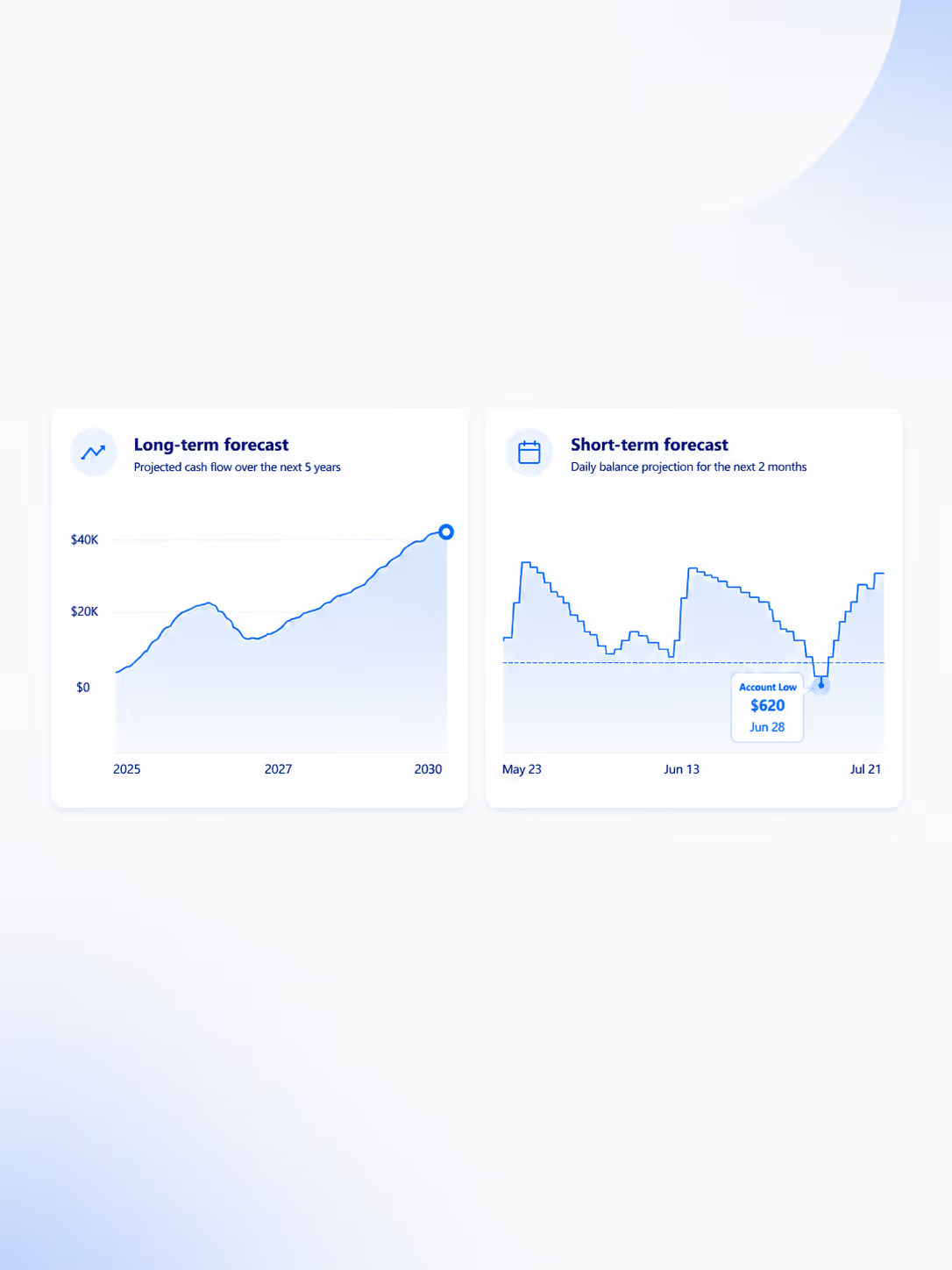
Account Low is your projected minimum checking account balance over the next 60 days. It's the lowest point your balance will reach based on your scheduled income and expenses, calculated by simulating your account forward in time, day by day. This simulation is what we call checking account cash flow forecasting—a method for projecting your balance forward to see where you're headed rather than just where you are. This single number transforms your current balance from a static snapshot into a dynamic forecast, showing you not just where you are, but where you're headed and what you can do about it.
Most people manage their checking accounts reactively. They check their balance, see a comfortable number, and assume they're fine until they check again. But this approach has two fundamental problems. First, you can't see trouble coming. By the time you notice your balance is dangerously low, you may have already triggered overdraft fees or missed payments. Second, you can't identify opportunities. That $3,200 balance might look healthy, but without knowing what's coming, you have no way to determine how much of it you truly need to keep on hand versus how much you could confidently spend or deploy.
Your Account Low solves both problems by revealing the critical inflection point in your cash flow. When you know the minimum balance you'll hit over the next two months, you gain the visibility to make proactive decisions rather than reactive corrections. This is the same principle that corporate treasury departments use to manage billions in liquidity, now applied to personal checking account management.
Account Low is your projected minimum checking account balance within the next 60 days. More specifically, it's the lowest point your balance will reach when you simulate forward through all your scheduled income and expenses.
This makes Account Low a worst-case scenario metric for your forecast period. It answers a fundamental question: is your current balance plus your scheduled income sufficient to support your upcoming expenses? If your Account Low is positive, the answer is yes - you can cover everything. If it's negative, the answer is no, and the number shows you exactly how much you're short.
Your current balance and available balance are snapshots - they tell you where you stand right now. Account Low answers a different question: what's the lowest your account will go over the entire forecast period based on what you expect to happen? When you know you'll bottom out at $500, you see that you have $500 that's available and unspoken for by what's coming - money that could potentially be deployed elsewhere because it's not needed to cover your obligations. When you know you'll bottom out at -$500, you see that you'll fall $500 short of your obligations - giving you advance warning and showing you exactly how much you need to deposit to close that gap. Without that worst-case visibility, you're making financial decisions in the dark.
Centinel calculates your Account Low by simulating your checking account forward in time. The process starts with your current balance and then applies each scheduled transaction on its expected date, moving day by day through the next 60 days. As the simulation progresses, it tracks your projected balance at each point and identifies the minimum value reached during that period.
Think of it as running a simulation of your financial future. If today is January 1st and your balance is $3,200, the system looks at what happens day by day from January 1st through March 1st—a 60-day forecast horizon. At each step, it's calculating what your balance would be, and it remembers the lowest number it encounters along the way. That lowest number is your Account Low.

This simulation incorporates all the financial events you've told Centinel about: recurring income like paychecks, recurring expenses like rent and loan payments, and one-time transactions you've added for upcoming expenses or expected deposits. Every time you add a transaction, adjust a recurring pattern, or update an assumption, the simulation recalculates instantly to show you the new projected minimum.
There's one more important aspect of how this calculation works: the simulation is deliberately designed to show you a conservative outcome. Specifically, it assumes that all debits post before credits on any given day. This isn't a technical limitation - it's an intentional design choice that has important practical implications for how reliably you can use the Account Low number.
The practical implication of this conservative approach centers on a real-world banking problem that catches many people off guard: the posting order problem.
Here's how it happens. Let's say you start a day with $1,000 in your account. During that day, your $2,000 paycheck gets deposited and your $1,500 rent posts. Logically, you should end the day with $500 in your account, and you should never go negative at any point since your paycheck more than covers the expense. But banks don't necessarily process transactions in real-time - they process them in batches throughout the day, and they have discretion over the order in which they apply those transactions.
If your bank processes the $1,500 debit before processing the $2,000 credit, your balance temporarily drops to -$500 before jumping to $500. Even though you finished the day with plenty of money and technically had the funds to cover the transaction, that momentary dip below zero can trigger a $35 overdraft fee. You wake up the next morning expecting to see $500 in your account, but instead you see $465.

This is where the conservative assumption becomes valuable. By assuming debits always post before credits, Account Low protects you from this scenario. If your Account Low shows a positive number, you know you can stay positive throughout the forecast period regardless of how your bank chooses to sequence transactions on any given day. The number you're seeing isn't an optimistic estimate that assumes everything posts in the most favorable order - it's a worst-case calculation that assumes everything posts in the most challenging order.
Now that you understand how Account Low is calculated and why it's built to show you a worst-case scenario, let's look at what this number actually tells you about your financial position and what actions you can take based on it.
Your Account Low serves different purposes depending on where your forecast lands. The number itself is neutral—it's simply showing you the lowest point in your projected cash flow—but the implications change dramatically based on whether that minimum point falls above or below zero.
When your forecast shows you'll stay positive throughout the next 60 days, your Account Low reveals something valuable: how much you can safely deploy right now. This number represents money that isn't needed to cover your scheduled obligations over the forecast period.
If your Account Low is $400, that means at your lowest point during the next two months - after all your scheduled bills have been paid and all your expected income has arrived - your balance will bottom out at $400. Since that's money you won't actually need to cover your obligations, you could withdraw that $400 today and still avoid going negative throughout the forecast. Your current balance might be $3,200, but the $2,800 difference between your current balance and your Account Low is already committed to covering your scheduled expenses and income patterns. The $400 is what's genuinely available.
This insight fundamentally changes how you think about surplus cash in your checking account. Without knowing your Account Low, you might look at that $3,200 balance and wonder how much you can afford to spend or deploy. But you have no objective way to determine what's truly available versus what's needed for upcoming obligations. With your Account Low visible, you can see that $400 represents money that's unspoken for by what's coming - money that could potentially be deployed elsewhere because it's not required to keep you positive throughout the forecast period. How much of that $400 you should actually deploy depends on additional factors like how confident you are in your forecast's accuracy, where you've set your comfort threshold (your Floor), and your overall risk tolerance.
The optimization question—how much to keep in checking versus how much to deploy elsewhere—is complex enough that we address it in depth in our guide on optimizing your checking balance. But the critical point here is that your Account Low provides the foundation for that analysis by showing you what amount is genuinely unspoken for by your scheduled obligations.
When your forecast shows your Account Low is negative, the metric shifts from revealing opportunity to revealing risk. A negative Account Low means that at some point in the next 60 days, based on your current trajectory, you'll overdraft your account. The specific number tells you how bad the shortfall will be.
If your Account Low is -$500, that tells you two important things. First, you will run out of money at some point during the forecast period. Second, you'll need to deposit at least $500 to avoid that overdraft, because that's how far below zero you're projected to go at your worst point.
This early warning is the safety value of Account Low. Instead of discovering you've overdrafted when you check your balance one morning and see a negative number plus fees, you can see the problem coming weeks in advance. And because Account Low shows your worst-case point, addressing that number solves all the overdraft issues in your forecast - including any earlier, smaller shortfalls that might occur along the way. That advance notice gives you time to take preventive action: you might pick up an extra shift at work, delay a discretionary expense, move money from savings to checking, or adjust your budget to reduce spending before the crunch point arrives.
The negative Account Low also shows you exactly how much intervention is required. You don't need to guess whether transferring $100 from savings will be enough—the forecast tells you that you need at least $500 to clear the gap, plus whatever buffer you want to maintain beyond just barely avoiding overdraft. This precision transforms crisis management from guesswork into a calculated response.
Account Low transforms how you engage with your checking account by replacing reactive balance-checking with proactive cash flow management. Instead of periodically logging into your bank to see if you have enough money, you're working with a forward-looking projection that shows you what's coming and gives you the visibility to make decisions before circumstances force your hand.
Whether you're using Account Low to avoid overdrafts or to confidently deploy surplus cash, you're applying the same principle that corporate treasury departments have used for decades: that managing money effectively requires seeing the full picture of your cash flow, not just a single moment in time. Your Account Low distills that complete forecast into one actionable number.
That shift from snapshot to forecast—from wondering if you have enough to knowing exactly what you can safely do with your money—is what transforms reactive financial management into strategic financial control. And it all starts with understanding the single most important number in your checking account: your projected minimum balance. Ready to create your own forecast? Learn how in our guide to creating a checking account cash flow forecast.
STAY A STEP AHEAD