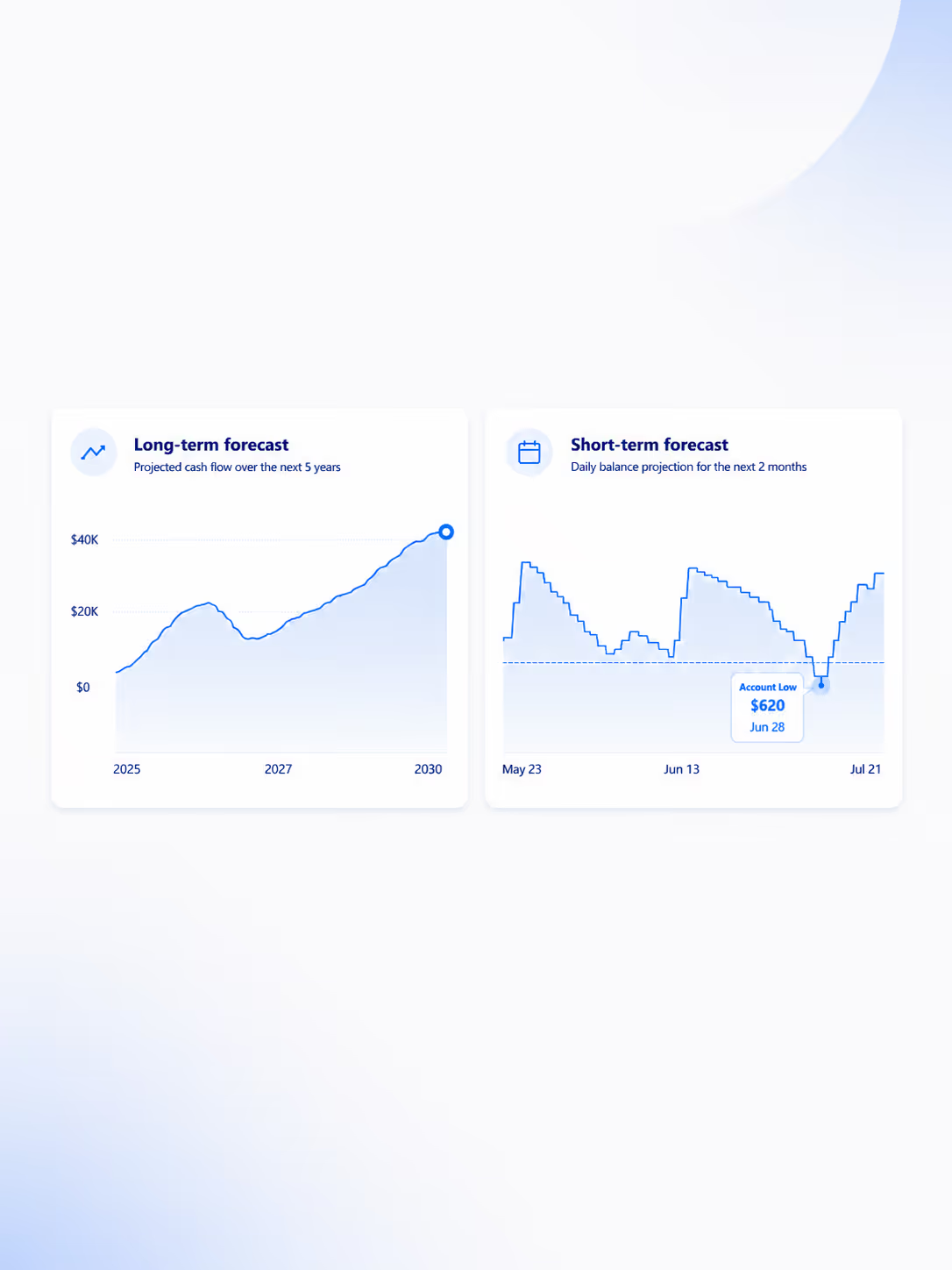
Monarch forecasts your net worth over years — not your checking balance day by day. See how Centinel’s forecast differs — and which fits you.
April 26, 2026

Monarch Money's forecasting projects your net worth and cash flow over years and decades. It does not project your checking account balance day by day. If the cash flow forecast you actually want is the one that tells you what your checking balance will be next week — and whether you can cover what's coming before your next paycheck — that's a different job than the one Monarch is built for.
Both apps can project your finances into the future, and the launch of Monarch Plus in April 2026 made the difference between them sharper, not smaller. Monarch is a comprehensive personal finance app: budgeting, investment tracking, savings goals, net worth monitoring, household collaboration, bill calendars, and more. With Monarch Plus, it adds long-horizon forecasting — a multi-year projection of net worth and cash flow that lets you model major life decisions like retirement, a home purchase, a new child, or a career break. The math runs in years and decades.
Centinel is a focused checking account forecasting tool. Forecasting isn't one feature among many — it's the entire product. Centinel runs a 2-month, day-by-day projection of your checking account to answer a narrower, more immediate set of questions: will your checking account cover what's coming over the next two months? If so, how much do you have free to spend, invest, or put toward debt? If not, when does the shortfall hit, and how much do you need to cover it? The math runs in days and weeks.
That single difference — decades at monthly resolution versus two months at daily resolution — is where every other difference comes from. The rest of this comparison walks through what each forecast is built to do, how they behave in practice, and which one fits the question you're actually trying to answer.
Disclosure: we make Centinel, so we have a stake in this comparison. We've worked to represent both apps accurately, and where Monarch is the better tool we say so.
Monarch's forecast is a long-horizon life-planning view: it projects where your overall financial picture is headed across years so you can model big decisions before you commit to them. Centinel's forecast is a single-account liquidity engine: it tells you whether your checking account can absorb what's coming over the next two months and hands you specific numbers to act on.
Monarch's forecasting lives in two places that are easy to confuse. Monarch Core, the base $99.99/year subscription, includes a Cash Flow view — but that view is a budgeting output, not a balance projection. It shows your monthly income against your budgeted expenses and goals to tell you what your plan says should be left over, and it visualizes where money has gone, often as a Sankey diagram. Useful for understanding your month. It does not walk your actual checking balance forward to tell you the low point you'll hit or whether you'll dip below $0 on a given day.
The genuine forecasting feature is in Monarch Plus, the $199/year premium tier launched in April 2026. Plus projects your net worth and cash flow over multi-year horizons from your real account data and a set of assumptions you can adjust. Its interactive timeline lets you drag major life events — retire at 58 instead of 65, buy a house in three years, take a year off work — and watch the projection update. The point is to model big decisions before you make them.
This design serves a real purpose. Major life decisions don't happen in a checking account; they play out across your whole financial picture, with effects that compound over years. A retirement decision depends on investment growth, withdrawal strategy, inflation, and Social Security timing. Monarch Plus gives you a unified, adjustable view of those long-horizon trajectories so you can compare scenarios with more confidence. The feature is currently desktop-web only — you can't model scenarios from the iOS or Android app.
Centinel’s checking account forecast is the product’s core: a 2-month, day-by-day projection of your checking balance. Every feature — the forecast ledger, the action metrics, the reconciliation system, and the notification architecture — exists to serve it.
The forecast answers two questions. First, is your account safe? Centinel projects your balance for every day over the next two months and checks each day against both $0 and a personal threshold you set, called your Floor. If your balance stays above your Floor the whole window, you're in good shape — and Centinel tells you exactly how much surplus you have, based on the lowest point your balance is projected to reach: Available = Account Low minus Floor. That surplus is money you can confidently spend or move to savings, investing, or debt without dipping below your comfort zone on any day. If your balance is projected to drop below your Floor or below $0, Centinel tells you when and by how much, so you can act before it happens.
That approach is borrowed from corporate treasury management, where finance teams have used the same principles for decades to manage organizational cash — forecast the position, set a minimum, deploy the excess. Centinel applies that rigor to your checking account.
The two products' purposes show up in nearly every design choice — what gets projected, what data drives it, and what the forecast hands you at the end.
This is the difference everything else follows from.
A 2-month daily forecast can be deterministic — calculated from known inputs rather than estimated from assumptions. Most of the cash moving through a checking account in any two-month window is already known: rent, paychecks, scheduled bills, car payments, insurance auto-debits. Centinel can project those with high confidence because they don't require assumptions about market returns or inflation — the next two paychecks are scheduled, the next mortgage payment is scheduled. Daily resolution matters here because the question being answered ("can I spend $80 tonight?") depends on which day a transaction lands, not just which month.
A multi-decade forecast cannot be deterministic. It has to assume an investment return, a wage curve, an inflation rate, a life trajectory. Monarch Plus makes those assumptions explicit and lets you adjust them, which is exactly right for the horizon: "can I retire at 58?" depends on aggregate trajectories, not on which day a single transaction posts. Daily resolution would be both impossible and useless across decades.
Neither resolution is a limitation. They're answers to different questions — and once you commit to a horizon, the rest of the design is downstream of it.
The two products take different inputs because they compute different outputs.
Monarch Plus is driven by life events and aggregate trajectories. You build the forecast by placing major events on a timeline and combining them with your account balances and growth assumptions to project net worth and cash flow over time. Individual recurring transactions feed in at an aggregate level — your average monthly spending, your typical monthly income — but the forecast isn't tracking specific transactions. It's projecting trends.
Centinel is driven by individual recurring transactions and reconciliation. It identifies your recurring bills and income, you confirm what it found and add anything missing, and it projects each one forward across the next two months. As real transactions post, Centinel matches them against your projected events to keep the forecast accurate, and surfaces anything that needs your attention in a review queue. The forecast is only as good as its inputs, so the matching is transparent and easy to correct.
The underlying split: Monarch Plus models the future as a function of decisions you might make. Centinel models it as a projection of cash flow events you've already scheduled. Both are legitimate; they answer different questions.
The output looks different on screen, and the difference reflects what each is for.
Monarch Plus shows a long-horizon trajectory — net worth curves across years, cash flow trends across months, scenario comparisons that show how a different retirement age or home purchase reshapes your financial future. The interface is exploratory: drag an event, change an assumption, watch the math update. The output is a picture of where you're headed under different choices.
Centinel shows specific numbers built to drive an immediate decision. The forecast tells you whether your account is safe or at-risk over the next two months. If you have surplus above your Floor, you see exactly how much is free to deploy. If you're headed for a shortfall, you see the date and the amount. It's the answer to "am I safe, and what should I do?"
A planning tool says, "here's what your life could look like." A decision tool says, "here's exactly what's happening this month and what to do about it."
It depends on which part of Monarch you're trying to replace.
If you use Monarch for budgeting, investment tracking, net worth, goals, or household collaboration, Centinel doesn't replace any of it — Centinel doesn't budget and doesn't touch your other accounts. And if the forecasting you want is the long-horizon kind — modeling retirement or a home purchase across years — Centinel isn't the alternative you're looking for; a long-range planning tool is.
But if the reason you opened Monarch was to get ahead of your checking account — to know whether the balance survives the month, what's safe to move, when a shortfall lands — Monarch was never built for that, and Centinel is. That's the narrow, honest sense in which Centinel is a Monarch alternative: a forecast-first tool for the short-term checking-account question, not a replacement for the full app. If you've been using Monarch for everything and squinting at it for that, the cleanest setup is both — Monarch for the long arc, Centinel for the next two months.
Choose Monarch if you want a comprehensive personal finance app — budgeting, investments, goals, net worth, household collaboration — with long-horizon forecasting layered on top to model major life decisions. The Plus tier is expensive, but for someone actively deciding on retirement timing, a home, or a career change, modeling those before committing has real value.
Choose Centinel if your live financial question is in the next two months, not the next two decades — whether your checking account covers what's coming, how much room you have, when a shortfall hits. You want specific, trustworthy numbers about one account, not a long-term trajectory to interpret.
The two aren't mutually exclusive. Monarch for long-term planning and overall management; Centinel for short-term checking liquidity. They answer different questions at different horizons, and the data each needs barely overlaps.
Centinel is currently in pre-launch. If you'd like to be among the first to try it, you can join the waitlist.
Monarch Core includes a Cash Flow view, but it's a budgeting output — your monthly income against budgeted expenses and goals — not a forward projection of your checking account balance. True forecasting is part of Monarch Plus, the $199/year premium tier launched in April 2026, which projects net worth and cash flow over multi-year horizons and lets you model major life events on a timeline. Plus's forecasting is currently desktop-web only.
Not day by day. Monarch Core's Cash Flow view shows a monthly budgeted net, and Monarch Plus projects net worth and cash flow at multi-year, monthly-or-yearly resolution. Neither tells you what your checking balance will be on a specific day next week. For a day-by-day projection of one checking account, that's what Centinel is built for.
In Monarch Core, the closest thing is the Cash Flow view, which reflects your budget — budgeted income minus budgeted expenses and goals for the month. For a forward projection, you need Monarch Plus, where you set assumptions and place life events on a timeline to project net worth and cash flow over years/decades. Neither produces a day-level checking-account balance forecast.
Monarch Core ($99.99/year) is the standard subscription: budgeting, account aggregation, spending reports, net worth tracking, basic investment tracking, household collaboration, and bill calendars. Monarch Plus ($199/year) adds Forecasting (long-horizon scenario modeling), Business Tracking, Investment Analysis (Morningstar-powered fund breakdowns), and a complimentary couples' will through Trust & Will.
No. Monarch Plus's forecasting projects net worth and cash flow at a multi-year, monthly-or-yearly resolution. It doesn't tell you what your checking balance will be on a specific day. That day-by-day projection is what Centinel is built to do.
No. Centinel is focused exclusively on checking account cash flow forecasting. For investment tracking, net worth, savings goals, or household budgeting, a tool like Monarch Money is designed for those jobs.
Yes. They solve different problems at different horizons. Monarch handles long-horizon planning and overall financial management; Centinel handles short-term checking liquidity over the next two months.
Monarch Core is $14.99/month or $99.99/year. Monarch Plus is $199/year and includes everything in Core.
Centinel offers a free tier for manual entry of recurring transactions. The premium tier — bank connectivity, automated syncing, transaction matching, and push notifications — is $7.99/month or $69.99/year, with a 30-day free trial.
STAY A STEP AHEAD