Checking account cash flow forecasting helps predict overdrafts before they hit and shows what’s actually safe to spend.
January 2, 2026

Your checking account balance answers exactly one question: how much money is in the account at this instant. It cannot tell you the two things you actually need to know. Whether you're safe — whether the balance survives the rent, the car payment, and the credit card bill that are all coming before your next paycheck. And whether there’s any amount sitting in the account that is genuinely yours to use or if it's already spoken for by upcoming bills.
A budget doesn't answer those questions either. A budget plans where money should go and records where it went. The discipline that actually answers these questions is older than personal finance software, and until recently it lived almost entirely inside corporate finance departments. This guide explains what it is, how it works, and what it lets you see that nothing else does.
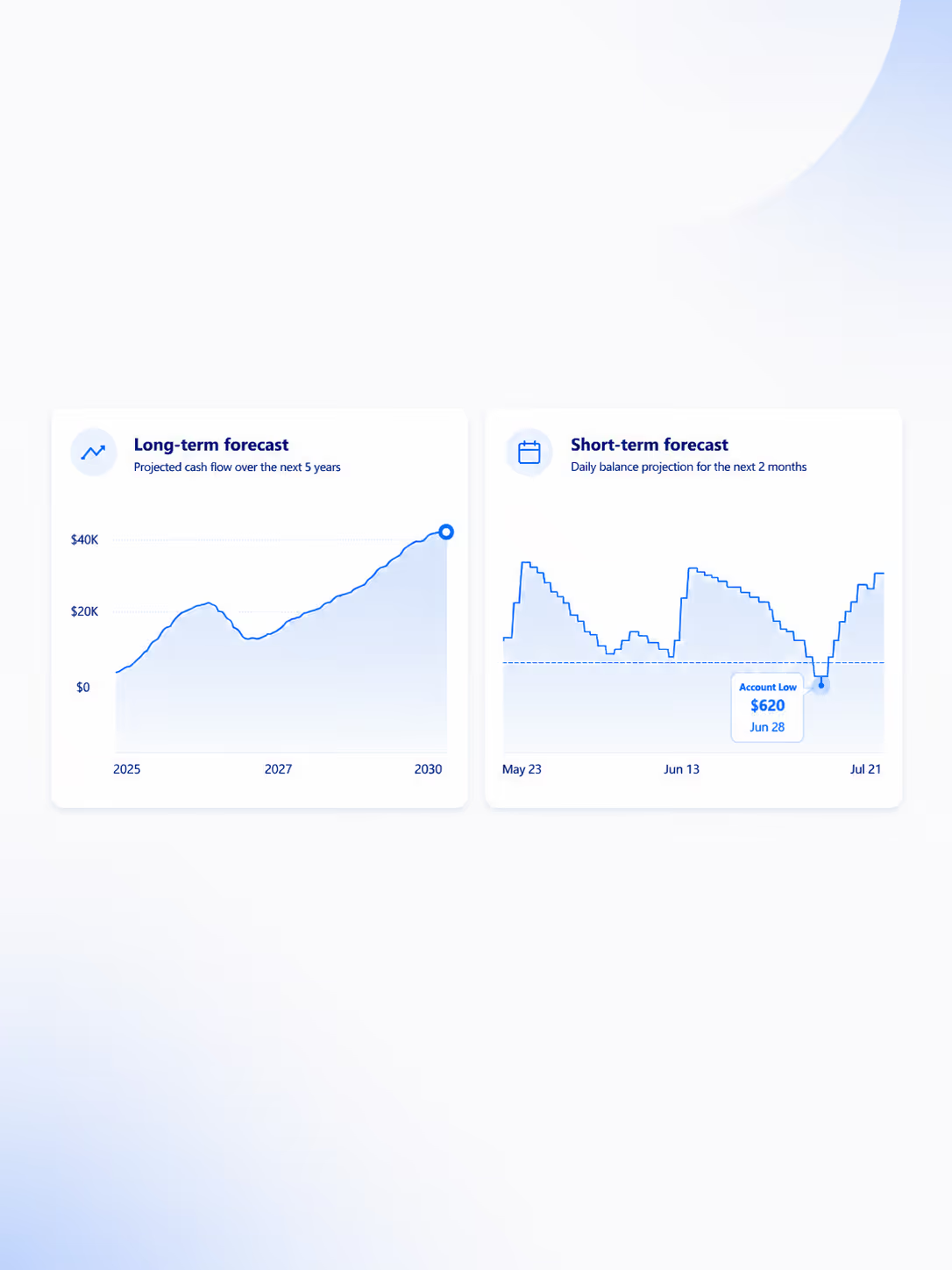
Checking account cash flow forecasting is a day-by-day simulation of your account's future balance. It takes what you have now and projects it forward across every scheduled deposit and withdrawal, producing a running line that shows what your balance will actually be on rent day, on payday, and on every day in between.
The closest familiar analogy is a weather forecast. A meteorologist takes current conditions and known patterns and projects them forward to tell you whether it will rain next Tuesday. A cash flow forecast does the same with money: it takes your current balance and your known financial events and projects them forward to tell you what your balance will be on a given future date.
A forecast needs three inputs: your current balance, your scheduled income, and your scheduled expenses. From there the mechanic is simple — walk the timeline forward one day at a time, adding income on the days it arrives and subtracting expenses on the days they post, and record the projected balance at the end of each day. Do that across a 2-month window and you have a complete picture of where the account is headed.
The table below forecasts an account that starts at $3,200. Rent posts on the 1st, a paycheck arrives the next day, a car payment and a credit card payment both land on the 10th, and the next paycheck arrives on the 16th.
You can create a checking account cash flow forecast yourself or use a tool that does it automatically and keeps it current.
Forecasting changes your relationship with your account on two fronts. It catches problems early enough to fix them, and it tells you which dollars are actually yours to use. Seeing the future isn't the point — being able to act on it is.
Most people discover a cash flow problem at the worst possible moment: when a payment bounces, when the overdraft fee posts, the day before something is due. By then the problem has already happened, and there isn't time to fix it.
A forecast inverts that. In the example above, the lowest point the balance is projected to reach – the Account Low – is $400: confirmation that the account stays above zero even on the tightest day. But suppose the credit card statement had come in $500 higher: $3,500 instead of $3,000. The same walk-forward would bottom out at −$100 on January 10th. That negative number isn't a crisis — it's a warning, surfaced 9 days before it happens. With that much lead time, you have options: pick up a shift, move money from savings, ask the card issuer to shift the due date by a week. The specific fix matters less than the shift in posture, from reacting to a disaster that already occurred to solving a problem you can still see coming.
The opposite problem is quieter. You see a balance sitting in checking and you're never quite sure how much of it you can actually touch. How much has to stay to cover rent next week, the car payment in 10 days, the bills scattered across the month? Without an answer, most people default to caution and leave more in the account than they need.
That caution is rational under uncertainty, but it has a cost: money in a checking account earns close to nothing, while equally safe, equally insured high-yield savings accounts pay substantially more. The forecast removes the uncertainty that justifies the caution. Return to the example: the account holds $3,200 today, which feels like several thousand dollars of room. But the forecast bottoms out at $400 on the 10th, and that low point is what actually governs how much you can move. You wouldn't move all $400 either; you'd keep some margin above $0 at your most exposed moment, which is its own question: how much to keep in your checking account. The gap between what the balance suggests and what's genuinely free is the entire point. Nothing except a forecast could have told you the real number is anchored to that $400 low.
The reason this approach is worth trusting is that it isn't an invention. It's a direct adaptation of what corporate treasury departments have done every day for decades — and the translation requires almost no adjustment.
Every large company has a treasury team whose core job is managing the company's actual cash. Their mandate runs between two failure modes that should sound familiar. On one side, running short: missing payroll, defaulting on a vendor payment, breaching a debt covenant. On the other, holding too much: cash sitting idle in a low-yield operating account when it could be earning a return or paying down debt. The treasurer's job is to navigate precisely between those two risks, every day.
Treasurers address both with the same three-part framework. First, they forecast cash flows — projecting known inflows and outflows day by day to turn the coming weeks into a visible balance trajectory rather than a guess. Second, they set a target balance — the minimum the operating account should carry to absorb variability and meet obligations without incident. Third, they deploy the excess. Anything sitting above the target gets moved automatically into higher-yield vehicles — money market funds, short-term investments, or applied against a line of credit — typically through a daily sweep that runs at the close of each business day. Forecast, threshold, deploy.
What's striking is how cleanly each element maps onto a personal checking account. The scale differs by several orders of magnitude; the logic is identical.
Two of those consumer terms are worth defining precisely, because the rest of the framework runs on them. Your Floor is the consumer threshold equivalent — the minimum balance you've decided you don’t want to drop below, set deliberately based on how stable your income is and how much cushion you need rather than pulled from a generic rule of thumb. Your Available Cash is what's deployable — the amount you can safely move out, calculated as Account Low minus Floor: the deployable figure is anchored to the lowest point in the forecast, because moving money out today lowers the entire curve, including the trough. Anything above your Floor at your most vulnerable moment is genuinely free; everything else is already committed. In the earlier example, a $400 Account Low against a $200 Floor leaves $200 of Available Cash — the precise version of the room the last section pointed at.
A balance tells you what you had a moment ago. A budget tells you where your money went last month. Neither tells you whether rent clears next Thursday, whether the surplus in your account is real, or whether a small purchase today causes a problem three weeks out.
A checking account forecast does, and that is the entire point. The questions that used to require guessing — am I safe, can I afford this, when do I need to act — turn into answers sitting in front of you. You don't have to be a corporate treasurer to manage money the way one does. You just have to be able to see what's coming. That's what Centinel is built to show you.
STAY A STEP AHEAD