Forecasting is the only reliable way to know what's safe to spend from your checking account. Here's the formula that gives you a specific answer.
March 10, 2026
You open your banking app and it says $4,200. The question you actually want answered is simpler than the number suggests: can I spend this? And the honest answer is that you can't tell from the balance alone — because some of that $4,200 isn't really yours to spend. Rent is due in six days. The car payment autopays Thursday. The credit card bill hits on the 15th. Part of that balance is already spoken for; the rest, if there is a rest, is what's genuinely safe to spend.
Your bank won't separate those two for you. It shows one number — the total — without distinguishing the money committed to upcoming bills from the money that's actually available. So most people guess, and because guessing high risks an overdraft while guessing low just leaves cash idle, they default to doing nothing.
There's a precise answer, and it comes from a single calculation: take the lowest balance your account is projected to reach over the next two months, subtract the minimum you want to keep on hand, and what's left is what's safe to spend. The sections below build that number up from scratch, then show it on real figures.
Your checking balance can't answer the question because it blends two different kinds of money into one figure.
The first kind is committed money — cash earmarked for obligations that will hit your account over the coming days and weeks. Rent, utilities, loan payments, the credit card bill. It's sitting in your account right now, but it isn't available in any meaningful sense; it belongs to transactions that haven't posted yet.
The second kind is uncommitted money — the surplus left over once everything coming due is accounted for. This is what's genuinely safe to spend, move to savings, or put toward debt.
Your bank reports these as a single total. When you see $4,200, you might have $800 of genuinely uncommitted cash, or $200, or nothing at all — the balance won't tell you which, because it's a record of every transaction that has already posted. That's a perfectly accurate history, and the wrong tool for a forward-looking question. To separate the committed money from the uncommitted, you have to stop looking backward and start looking forward.
Looking forward means projecting your balance through everything that's coming — your income and your obligations — to see where it actually ends up. That projection is a checking account cash flow forecast: you start from today's balance, lay in every known income and expense with its date, and walk the balance forward day by day.
Find your projected low point. As the forecast walks forward, your balance rises when income lands and falls when bills post. Somewhere in that window it reaches its lowest point before recovering. That low point — your Account Low — is the only moment that determines whether you're safe, because if your balance clears its worst day, it clears every other day too. A balance that looks comfortable today is irrelevant if it's projected to bottom out at -$200.
Subtract the minimum you want to keep: your Floor. Your Account Low is the lowest balance your forecast projects. Your Floor is the line you do not want your checking account to fall below, even at that low point. Someone with a steady paycheck might set it at $500; someone with variable income might set it at $2,000. Setting it deliberately, rather than carrying a vague sense of "enough," is the substance of how much to keep in your checking account.
Take the difference. With those two numbers, the answer is one line:
Available Cash = Account Low − Floor
That's the amount you can spend or move without your balance being projected to fall below your personal minimum at any point in the forecast — not a rule of thumb, not a guess, a specific figure you can act on.
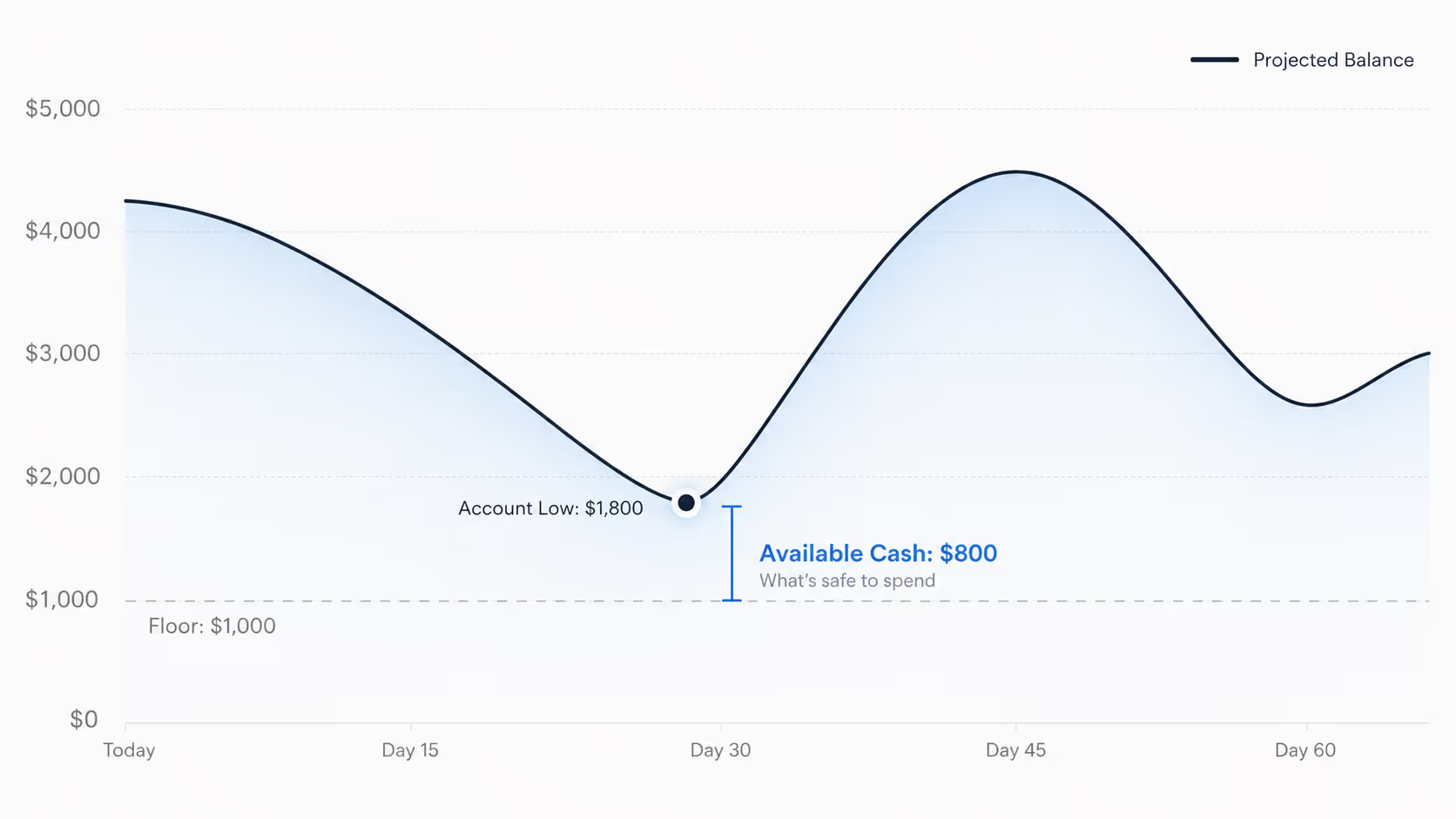
The image at the top of this page shows the whole mechanic. The balance opens at $4,200 and is drawn down by upcoming bills — rent, a car payment, a credit card bill — to a low of $1,800. That trough is the Account Low. Set a $1,000 Floor, and the distance between them is what's safe to spend:
Account Low: $1,800 (the lowest the balance is projected to reach)
Floor: $1,000 (the minimum you choose to keep)
Available Cash: $800
The opening balance told you nothing useful. The number that actually mattered wasn't the $4,200 you saw today — it was the $800 you couldn't see, more than five times smaller and a month of bills away. Pulling those two apart is the entire difference between guessing and knowing.
You started with $4,200 and a question the number couldn't answer — not because the balance was wrong, but because it was the wrong kind of number. A backward-looking total when you needed a forward-looking projection; one figure where you needed two kinds of money pulled apart.
Whether you keep it in a spreadsheet or let software run it, the math is the same; what determines whether the answer holds is keeping your inputs current. The best "safe to spend" app for a checking account has to do this automatically: project the balance forward, find the low point, subtract a Floor, and keep the forecast current as bills, income, and transactions change. That is the version of the problem Centinel is built for. It connects to your account, keeps the forecast current automatically, and surfaces your Account Low and what’s safe to spend as your balance moves.
However you run it, the shift is the same: the answer to "what's safe to spend" was never in your balance. It was always in your forecast.
It's the amount you can spend or move without your balance dropping below the minimum you want to keep, at any point before your situation recovers. Concretely, it's your lowest projected balance over the next two months (your Account Low) minus your chosen minimum (your Floor).
Usually not all of it. Your current balance includes money already committed to upcoming bills that haven't posted yet. The portion that's genuinely safe to spend is whatever clears your Floor at the account's lowest projected point — often well below the number your bank displays.
Project your balance forward through every upcoming income and expense, find the lowest point it reaches (the Account Low), and subtract the minimum you want to keep on hand (the Floor). The result — Available Cash = Account Low − Floor — is what's safe to spend.
No. Your bank's available balance only adjusts the current total for pending transactions and holds. It doesn't account for bills due next week or your next paycheck, so it still overstates what's genuinely free to spend.
Once you’ve identified a reliable surplus, you can decide what to do with extra money in your checking account instead of letting it sit idle: build emergency savings, pay down high-interest debt, or move it to investments.
Two months is the practical window. It's long enough to capture bills that are coming but not yet imminent, and short enough that the projection stays reliable rather than drifting into guesswork.
This article is for informational purposes and reflects one approach to managing your checking account. It's not financial advice, and your situation may require different considerations. When in doubt, consult a financial professional.
STAY A STEP AHEAD