Explainer
11
min.

What Consumers Can Learn from Corporate Cash Management

The same framework Fortune 500 teams use to manage cash — forecast, find the low point, deploy the surplus — works for your checking account.

March 10, 2026
Woman staring down at papers strewn across her kitchen table, visibly stressed about budgeting.

You have $3,200 in your checking account. You know you should probably do something with at least some of it — move a chunk to your high-yield savings account, make an extra payment on your credit card, maybe put a few hundred into your investment account. But you also know that rent comes out on the 1st, your car payment is due next week, and you have two credit card payments in the next two weeks. You're not entirely sure how much you need to keep on hand. And the last thing you want is to move too much and trigger an overdraft.

So you do what most people do: nothing. The money sits in your checking account, earning essentially zero, because you don't have the information you need to act with confidence.

This is the fundamental tension at the heart of checking account management, and nearly every consumer faces it. You're navigating between two failure modes that pull in opposite directions.. The first is the shortfall problem — you run out of cash before you realize it's happening. A payment bounces, an overdraft fee hits, and you're scrambling to fix something that's already gone wrong. The second is the idle cash problem — you keep more in checking than you actually need because you're afraid of triggering the first problem. That excess sits there earning almost nothing while it could be working for you elsewhere.

Most people think of these as separate concerns. They're not. They're two sides of the same coin, and they both stem from the same root cause: you're making financial decisions based on a static number — your current balance, which doesn’t actually show you what you can spend — rather than a forward-looking view of where your money is actually headed.

Here's what's interesting: there's an entire professional discipline that solved both of these problems decades ago. It runs on the same logic you'd need to manage your own checking account well. It's just that, until very recently, it was only available to corporations.

What Corporate Treasury Teams Actually Do

Every Fortune 500 company — and most mid-size companies — has a treasury department. If you've never worked in corporate finance, you've probably never heard of it. It doesn't generate headlines. Nobody makes movies about it. But it's one of the most critical functions in any large organization, and what it does on a daily basis is remarkably relevant to the problem described above.

A corporate treasury team's core job is managing the company's cash. Not investing it in growth initiatives, not deciding corporate strategy, not setting prices — just managing the actual cash that flows in and out of the company's accounts. Their mandate sounds simple: make sure the company always has enough cash on hand to meet its obligations, while never leaving excess cash sitting idle in low-yield accounts. In practice, this is a sophisticated daily operation.

Treasury teams operate in the space between two risks that should sound familiar. On one side, running short — which in a corporate context means potentially missing payroll, defaulting on a vendor payment, or violating a debt covenant. On the other side, holding too much — which means cash that could be earning returns in money market funds, short-term investments, or debt reduction is instead sitting unproductive in an operating account. The treasurer's job is to navigate precisely between these two risks, every single day.

The daily process looks something like this. The treasurer starts each morning by checking the company's cash position — how much is sitting in each bank account right now, across all the entities and accounts the company operates. This is the starting point, but by itself, it's not enough to make decisions. Knowing you have $50 million in cash right now doesn't tell you whether that's more than enough or dangerously thin. The answer depends entirely on what's coming next.

So the treasurer runs a cash flow forecast. Starting from the current cash position, they project forward day by day through the company's known inflows — customer payments, investment maturities, intercompany transfers — and known outflows — payroll, vendor payments, debt service, tax obligations, capital expenditures. The result is a projected balance trajectory: a day-by-day simulation of how the company's cash will rise and fall over the coming days and weeks.

This forecast reveals something critical: the company's projected low point — the specific day when cash dips to its minimum before the next major inflow recovers it. In treasury language, this is called the cash trough, and it's the single most important number the forecast produces, because every subsequent decision flows from it.

The treasurer compares the cash trough to the company's minimum balance policy — a predetermined threshold below which the company has decided it's not willing to let cash fall. This isn't a guess or a rough estimate. It's a deliberate policy decision based on the company's risk tolerance, the variability of its cash flows, and the cost of emergency funding if they were to come up short.

If the projected trough is above the minimum, the difference represents excess liquidity — cash the company can safely deploy into short-term investments, money market funds, or accelerated debt repayment. If the projected trough is below the minimum, the treasurer has advance warning and time to arrange funding before the problem arrives.

The key principle governing everything treasury teams do is this: idle cash is a cost, and surprise shortfalls are a crisis. The job is to eliminate both simultaneously. This isn't done by guessing. It isn't done by maintaining a massive buffer "just in case." It's done through forecasting — projecting forward through known cash flows to see exactly what's coming, so that every dollar is either covering a known obligation or working productively elsewhere.

That forecasting isn't a one-time exercise — treasury teams treat it as a daily operational discipline, continuously reconciling projections against actual cash movements and updating inputs as amounts and timing shift, because a forecast built on stale assumptions produces the same blind spots as having no forecast at all. For consumers, maintaining an accurate checking account forecast follows the same logic at a smaller scale.

This process — check your position, forecast forward, find the low point, compare to your minimum, and act on the difference — has been refined over decades of corporate practice. It's elegant, it's effective, and it requires remarkably little translation to apply to your personal checking account.

The Corporate Treasury Process, Translated to Consumer Finance

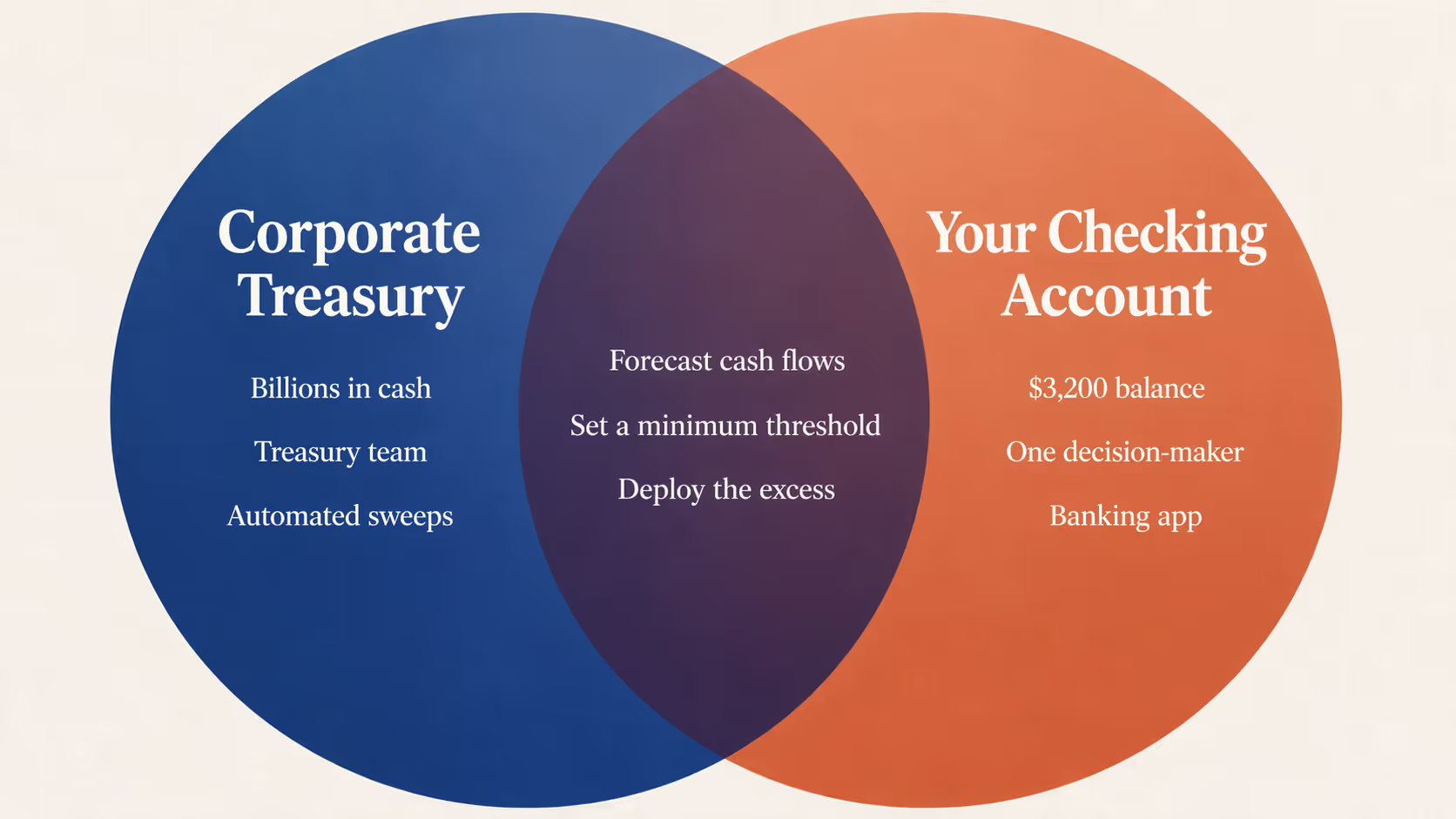
What's striking about the corporate treasury process isn't its complexity. It's how directly every element maps to what consumers face with their own checking accounts. The scale is different. The stakes are different. But the logic is identical.

This parallel is more than an analogy — it's the exact framework embedded in the mechanics of how a checking account cash flow forecast actually works, and it's what Centinel, a personal finance app, translates into consumer equivalents. Here's how the mapping works.

Cash Position → Current Checking Balance

In corporate treasury, the cash position is the starting point for everything. The treasurer checks how much the company holds across all its accounts at this moment. It's necessary but insufficient — knowing where you stand right now tells you nothing about where you're headed. For consumers, this is what your banking app shows you when you open it: a balance. You see $3,200, but that number doesn't tell you whether you'll still have $3,200 after rent, your car payment, and your credit card bill all hit over the next two weeks. The current balance is a snapshot, not a forecast — and the difference between those two things is where most financial stress originates.

Cash Flow Forecast → 60-Day Cash Flow Forecast

Starting from the cash position, the corporate treasurer projects forward day by day through known inflows and outflows, producing a projected balance trajectory. This is the core analytical tool in treasury — without it, everything else is guesswork. The consumer equivalent is the same process applied to your personal cash flows. Start with today's balance, layer in your paychecks, rent, subscriptions, loan payments, and any one-time items you know about, and simulate the balance forward day by day over a 60-day window. The result is a projected trajectory showing exactly how your checking balance will rise and fall — and, critically, where it's going to dip.

Cash Trough → Account Low

This is the single most important number in any cash flow forecast, corporate or consumer. The cash trough is the lowest point the projected balance will hit before the next major inflow recovers it. It's the vulnerability point — the moment where, if anything is going to go wrong, it will go wrong. For consumers, this is your Account Low: the lowest your checking balance is projected to reach over the forecast window. If this number is negative, you're headed for an overdraft. If it's positive, it tells you how much buffer you actually have at your most vulnerable point — which is far more useful than knowing what you have right now.

Minimum Balance Policy → Floor

Every corporate treasury department sets a policy minimum — the floor below which the company is not willing to let its cash drop. This isn't a number someone pulled from a rule of thumb. It's a deliberate decision reflecting the company's risk tolerance and the variability in its cash flows. For consumers, the equivalent is your Floor — the minimum balance you're personally comfortable maintaining in your checking account. This number reflects your own financial reality: how stable your income is, how predictable your expenses are, and how much cushion you need to sleep at night. Setting this number deliberately, rather than keeping a vague 'enough,' is one of the most important things you can do for your financial clarity — because your Floor is, at its core, the answer to one of the most common questions in personal finance: how much should I keep in my checking account.

Excess Liquidity → Available Cash

In treasury, excess liquidity is the amount of cash safely above the minimum balance policy, even at the forecast's lowest point. This is the money the company can and should deploy — into short-term investments, money market funds, or debt reduction. Leaving it idle is considered a failure of cash management. For consumers, this is your Available Cash: calculated as Account Low minus Floor. It represents the amount you can confidently move to a high-yield savings account, use to pay down credit card debt, or invest — because even at your most vulnerable point in the forecast, you'll remain above your personal minimum. Understanding and acting on this number is the core of checking account optimization.

Here's how the complete mapping looks:

Corporate Treasury Consumer Equivalent In Practice
Cash Position Current Checking Balance Your starting point — what your banking app shows right now
Cash Flow Forecast 60-Day Cash Flow Forecast A day-by-day simulation of how your balance will rise and fall
Cash Trough Account Low Your projected lowest balance — the most vulnerable point in your forecast
Minimum Balance Policy Floor The minimum balance you're personally comfortable maintaining
Excess Liquidity Available Cash Account Low minus Floor — the amount you can confidently deploy

The pattern is consistent and complete. Every element of the corporate treasury process has a direct consumer equivalent, serving the same function at a different scale. The framework doesn't need to be adapted or approximated. It translates.

The Principle Corporate Treasurers Live By

The structural parallel between corporate treasury and consumer checking account management is striking. But there's a deeper principle underneath it that makes the comparison even more instructive.

Corporate treasury teams are evaluated on two dimensions simultaneously: they must never allow a surprise shortfall, and they must never leave excess cash sitting idle. Both matter. But the one that separates good treasury management from mediocre treasury management is the second one — the relentless intolerance for idle cash.

In corporate finance, leaving excess cash in a non-interest-bearing operating account isn't considered "playing it safe." It's considered a management failure. If a treasurer has $10 million sitting unproductively in an account that could be earning returns in an overnight investment, that's lost income the company will never recover. The company didn't lose money through a bad decision — it lost money through the absence of a decision. Treasury teams are measured, in part, on how efficiently they deploy their excess liquidity. Holding cash beyond what's operationally necessary isn't caution; it's waste.

The goal isn't to minimize cash — that would create dangerous shortfalls. The goal is to hold exactly enough to meet obligations through the forecast's low point, and put everything above that to work. No more, no less.

Consumers face the exact same dynamic but respond to it very differently. The average American household keeps thousands of dollars more in their checking account than their cash flow actually requires. That excess earns almost nothing — the national average checking rate is 0.07% APY — while high-yield savings accounts, equally safe and equally FDIC-insured, pay 4% or more. The result is a hidden cost that compounds quietly over time, year after year, without the consumer ever seeing a bill for it.

Why the different behavior? It's not a matter of sophistication or financial literacy. It's a matter of information. A corporate treasurer can tell you, to the dollar, how much cash is excess, because they have three things: a forward-looking forecast, a known low point, and a defined minimum. With those three inputs, the calculation is straightforward — anything above the minimum at the worst point in the forecast is deployable.

Consumers have none of these things. Without a forecast, you can't identify your low point. Without a low point, you can't compare it to a minimum. Without that comparison, you have no idea how much is genuinely excess. So you do the rational thing given the information available: you keep more than you probably need, because you don't know what you need. The conservatism isn't irrational — it's the predictable response to an information gap.

But the information gap is what needs to close. The question of how much to keep in checking isn't actually that hard to answer once you have the same visibility that a corporate treasurer has. It just requires the same three inputs: a forecast, your Account Low, and a deliberate Floor.

Why This Framework Is New for Consumers

If the corporate treasury parallel is this clean and the framework is this well-established, a natural question emerges: why hasn't someone translated it for consumers before?

A few factors explain the gap. The most significant is that consumer financial tools evolved from a fundamentally different tradition — budgeting. Budgets are built around the question "where do I want to allocate my money and where did it go?" They set limits on future categories, categorize past spending, and help people understand their spending patterns. This is useful, but it doesn't produce the thing that actually solves the two core problems mentioned above. The treasury approach starts from a different question entirely: not "where did my money go?" but "where is my money going, and when?" Most personal finance tools are built around the budgeting question, which is why they don't produce the same outputs that treasury tools do.

The infrastructure gap mattered too. Corporate treasurers have always had direct, real-time data feeds from their banking systems. Consumers only gained reliable programmatic access to their own bank data through open banking infrastructure in the last several years. Without real-time balance data and transaction history flowing into a forecasting tool, the consumer version of treasury management would have been entirely manual — possible, but with enough friction to limit adoption.

And the framing itself is new. The insight that the same five-step process — check your position, forecast forward, find the trough, compare to your minimum, deploy the surplus — works at any scale is not something that existed in the personal finance conversation. It required someone to look at consumer checking account management through the lens of corporate treasury and recognize that the problems are structurally identical.

Centinel is built around exactly this framework — translating each element of corporate treasury management into a tool that works for individual checking accounts. But regardless of the tool, the framework itself is what matters. Forecasting forward, identifying your projected low point, setting a deliberate minimum, and deploying the surplus above it isn't a corporate luxury or a concept that only applies at scale. It's a financial practice that has worked for decades in corporate finance — and consumers have been missing it.

More Resources

STAY A STEP AHEAD

Limited Early Access.

Join the waitlist for priority access to Centinel’s launch and get invited to test features before the general public.