A checking account forecast starts accurate. Keeping it that way requires a current balance and current cash flow events. Here's how — from manual to automated.
March 15, 2026
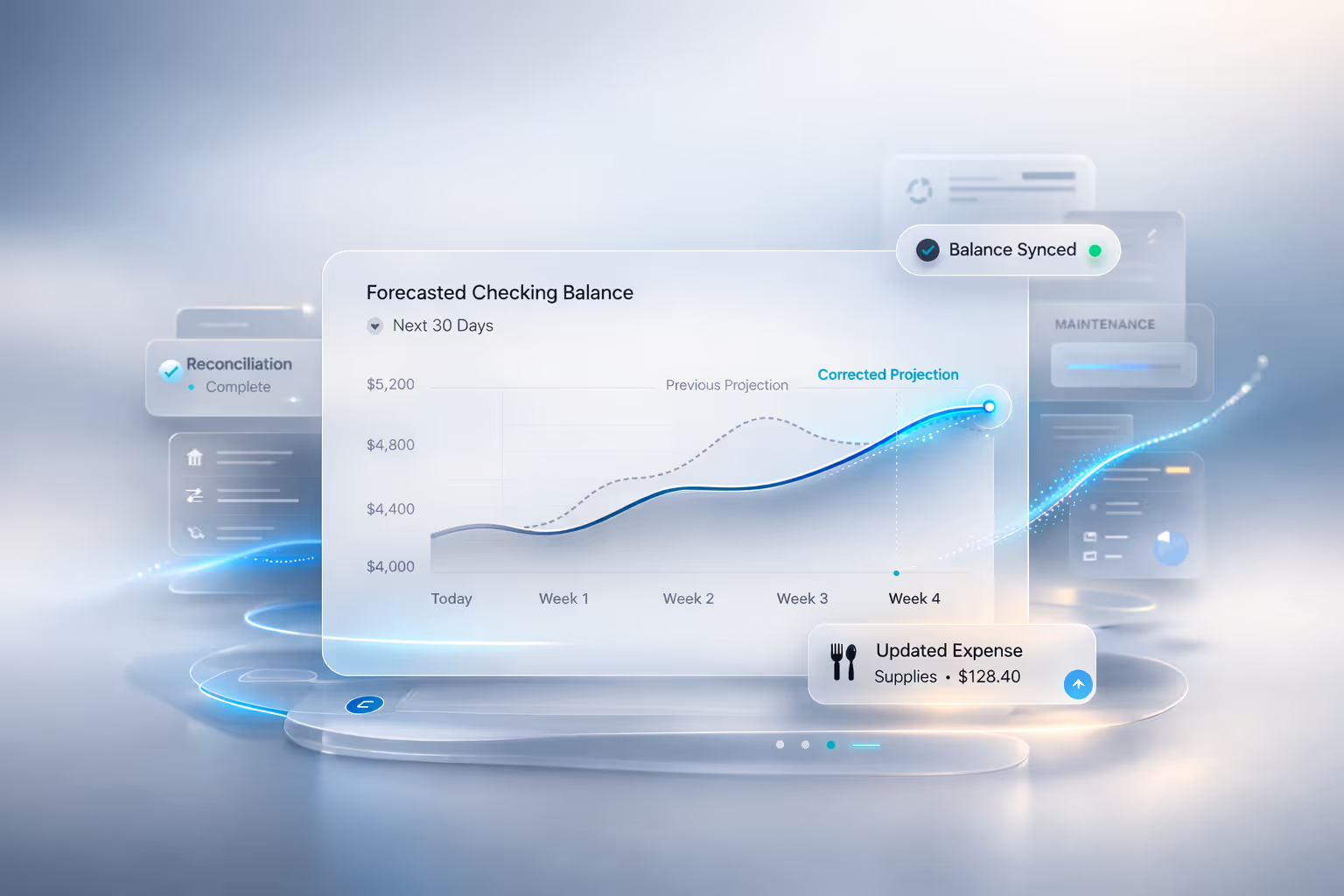
You built your forecast. You entered your paychecks, your rent, your car payment, your subscriptions. You set your starting balance. And on the day you created it, everything was right — the projected balance matched reality, the upcoming events reflected what was actually going to happen, and the numbers you were looking at meant something.
That was two weeks ago. Since then, your electricity bill came in $18 higher than you estimated. You signed up for a new streaming service and forgot to add it to your forecast. And you haven't updated your starting balance since last Tuesday, so the forecast is still projecting forward from a number that's no longer accurate.
None of these are dramatic failures. Each one is small — a few dollars here, a day there. But they compound. After two weeks of small, uncorrected discrepancies, your forecast could be off by hundreds of dollars. The projected balance your forecast is showing you three weeks from now might bear little resemblance to what will actually be in your account. And if the numbers aren't reliable, the entire purpose of checking account cash flow forecasting — knowing whether you're safe, knowing what you can spend — is undermined.
This is the fundamental challenge of maintaining an accurate forecast, and it comprises just one of the components of how a checking account forecast actually works. Building one is a discrete act. Maintaining one is an ongoing practice. The forecast doesn't degrade because of one big mistake. It degrades because of the steady accumulation of small differences between what you assumed would happen and what actually happened. Maintenance is the discipline of catching those differences and correcting them before they erode the forecast's reliability.
That discipline comes down to two things: keeping your starting balance current and keeping your cash flow events current. Everything else flows from those two pillars.
A checking account forecast works by starting with your current balance and walking forward day by day, adding income and subtracting expenses on their scheduled dates. This means the starting balance is the foundation of every number the forecast produces. If it's wrong, every subsequent projection inherits that error — not because the forecast logic failed, but because it's calculating correctly from an incorrect starting point.
Think of it like setting a GPS route. If you tell the GPS you're starting from an intersection three blocks east of where you actually are, every turn-by-turn instruction it gives you will be technically correct based on its assumption but practically wrong based on your reality. The same thing happens when your forecast's starting balance is stale. The projected ups and downs are calculated correctly, but they're all anchored to a number that no longer reflects where you actually stand.
On Centinel's free tier, or in any spreadsheet-based forecast, this means periodically opening your bank's app, checking your current balance, and entering it into the forecast. For a high-activity account, doing this every day or two keeps the foundation solid. For a lower-activity account, every few days might be sufficient. The key is building the habit so the starting balance never drifts far from reality.
Centinel's Premium tier removes this step entirely. Your checking account connects via Plaid, and your balance syncs automatically — so every time the forecast recalculates, it's working from your actual current position. This is the single simplest maintenance task that automation solves, and it's arguably the most impactful, because every other number in the forecast depends on it.
Your starting balance is the foundation, but your cash flow events — the income and expenses you've scheduled in the forecast — are the structure built on top of it. These events define the projected trajectory: when the balance rises, when it falls, and where it ultimately bottoms out. If the starting balance is wrong, the whole forecast shifts up or down. If the cash flow events are wrong, the forecast's shape is wrong — it's projecting rises and falls that won't actually happen as described.
Cash flow events change in two fundamentally different ways, and recognizing the distinction helps you maintain your forecast more effectively.
The first type of change involves events that already exist in your forecast, but where the actual amount or timing differs from what you projected. Your credit card statement closes and the actual payment is $847 instead of the $900 you estimated. Your electricity bill comes in at $168 because it was an unusually hot month, up from the $150 you had saved. Your paycheck is $30 lower because you didn’t work as many hours as you had anticipated.
These are expected events where the specifics shifted. The transaction still happened — it just didn't match your projection precisely. Each individual variance might be small, but they add up. Five events that are each $15 to $30 off from their projections create $75 to $150 of cumulative error in your forecast. Over several billing cycles without correction, these variances can make the difference between your forecast showing a comfortable surplus and the reality being a much tighter margin.
On Centinel's free tier, or in a spreadsheet, catching these variances is the most hands-on part of the maintenance practice. It means periodically reviewing what has actually posted to your bank account and comparing it to what your forecast predicted. When your electricity bill arrives and it's higher than expected, you update the amount for next month's projection. When your credit card statement closes, you replace your estimate with the actual figure. When your paycheck differs, you investigate whether it's a one-time adjustment or a permanent change. The habit of comparing what actually happened to what you forecasted — and updating accordingly — is what prevents small variances from silently accumulating into large errors.
Centinel's Premium tier handles this comparison systematically rather than relying on your memory. When a bank transaction posts, Centinel's transaction matching algorithm scores it against your saved events using signals like amount, date, merchant name, and category to determine which forecasted event it corresponds to. If the transaction matches an event but the amount differs significantly — your electricity bill was $250 instead of the forecasted $150 — the system detects the discrepancy and surfaces it. You still decide how to handle it (update the recurring amount, leave it as a one-time variance, adjust future projections), but the detection happens automatically rather than depending on you to remember to check every event.
The second type of change is more consequential: it's not a variance in an existing event, but a change to the recurring pattern itself. You get a raise and your net paycheck permanently increases. Your rent goes up when your lease renews. You take on a new car loan payment that didn't exist before.
These changes don't just affect one forecast period — they affect every future projection until corrected. If your rent went up by $100 last month and you haven't updated the forecast, the error isn't a one-time $100 discrepancy. It's $100 this month, $200 cumulative next month, and growing from there. Structural changes have a compounding effect on forecast accuracy because the incorrect amount keeps repeating.
The maintenance habit here is different from variance adjustments. Instead of comparing amounts after the fact, you need to recognize when something in your financial life has changed and ask: does this affect my forecast? A new job, a lease renewal, a new loan — these are all triggers to update your cash flow events. Some are obvious (you know you got a raise). Others are easy to miss (an annual payment you forgot to add is about to post).
Centinel's Premium tier can surface some of these structural changes through the bank feed via its reconciliation functionality. If a new recurring charge starts appearing in your account that doesn't match any saved event, Centinel flags the unmatched transaction for your review — and you can add it as a new recurring event directly from the reconciliation queue, so it's tracked going forward. Similarly, if Centinel expects a forecasted event to post during its expected window and no corresponding bank transaction appears, it flags that the expected event didn't occur. These alerts help catch structural changes that might otherwise go unnoticed until the cumulative error becomes significant.
Credit card payments deserve a specific mention because they sit at the intersection of both types of change. Unlike most recurring expenses — where you know the amount in advance (rent, car payments, insurance) or can estimate it within a narrow range (utilities) — credit card payments are a delayed aggregation of an entire billing cycle's spending. The amount isn't resolved until your statement closes, and it can vary significantly from month to month. On top of that, you choose how much to pay: the full statement balance, the minimum, or something in between. This means that even after the statement closes, the actual checking account outflow depends on a decision you make — and that decision might change month to month based on your broader cash flow situation. The result is that credit card payments occupy a unique position in a checking account forecast: they're large enough to meaningfully move your projected balance, the amount is structurally unknowable until the statement closes, and the final payment involves a choice. Centinel's Premium tier addresses this directly — when you connect a credit card via Plaid and set your payment preference (full statement balance, minimum payment, or a custom amount), Centinel detects each new statement and automatically updates your forecast with the actual projected payment, removing the manual tracking burden from what is often the single most variable line item in the forecast.
A forecast that hasn't been maintained can quietly mislead you. It might overstate what’s available to invest or spend, which means you might move or spend money that isn’t actually available. Or it might miss a coming shortfall entirely because a new expense was never added, meaning you don't get the overdraft warning you need. Maintenance is what separates a forecast you can trust from one that's gradually drifting away from reality.
Corporate treasury teams understand this intuitively. In corporate cash management, maintaining the cash flow forecast isn't a periodic task — it's a daily operational discipline. Centinel brings this same discipline to consumer checking accounts. On the free tier, Centinel gives you the structure to maintain your forecast manually — you update your balance and adjust your events, and the forecast recalculates instantly. On the Premium tier, Centinel connects to your checking account and credit cards via Plaid, syncs your balance automatically, and uses a transaction matching algorithm to compare what actually posts to your bank against what your forecast predicted. High-confidence matches are handled silently. Ambiguous items surface in a reconciliation queue for quick resolution. The result is a forecast that stays current with significantly less manual effort — so the numbers you're relying on to make decisions actually reflect what's happening in your account.
STAY A STEP AHEAD