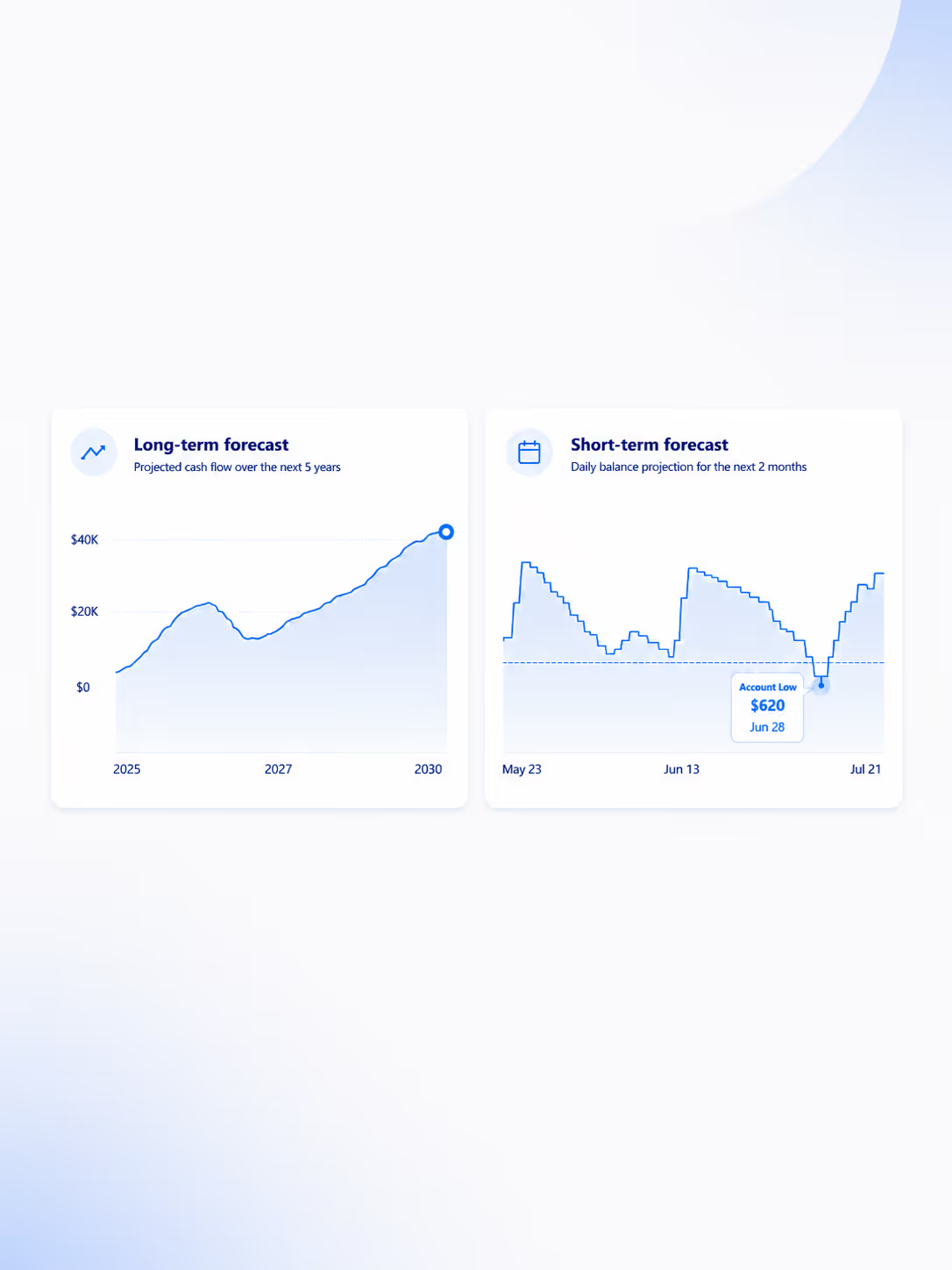
Simplifi projects cash flow across accounts; Centinel forecasts your checking account day by day to show if your account is safe or at risk.
March 28, 2026

Quicken Simplifi's Projected Cash Flow charts where all your account balances are headed, from two weeks out to a full year. Centinel forecasts cash flow too — but only for your checking account, only over the next two months, and toward a different end: telling you exactly how much you can safely spend, or precisely what you need to cover an upcoming shortfall.
Both genuinely project balances forward, so this isn't a case of one app forecasting and the other not. It's that they're built to answer different questions. Simplifi's forecast is a planning view across every account — where your money is headed over months and the year. Centinel's is a decision tool for the one account where day-to-day timing causes overdrafts, missed bills, and the low-grade anxiety of not knowing whether you can afford what's in front of you.
Disclosure: we make Centinel, so we have a stake in this comparison. We've worked to represent both apps accurately, and where Simplifi is the better tool we say so.
Simplifi's forecast is a multi-account financial trajectory — it shows where all your balances are headed so you can plan ahead. Centinel's forecast is a single-account liquidity engine — it tells you whether your checking account can absorb what's coming and hands you specific numbers to act on.
Simplifi is built around the Spending Plan, which tracks your monthly income against bills, subscriptions, planned variable expenses, savings goals, and everything else to tell you how much is left this month. Projected Cash Flow lives within the Bills & Income section as a complementary view.
That forecast shows multiple account trajectories on one graph — checking, savings, and credit cards each appear as a colored line, and you can toggle accounts on and off to watch how balances move over time. The window defaults to one month and stretches to a year or shrinks to two weeks. On mobile, it surfaces today's balance next to the projected balance at the end of the selected window, reinforcing the directional, trajectory-oriented purpose. It's a flexible planning aid for seeing what's coming across your whole financial picture.
Centinel’s checking account forecast is the product’s core: a 2-month, day-by-day projection of your checking balance. Every feature — the forecast ledger, the action metrics, the reconciliation system, and the notification architecture — exists to serve it.
The forecast answers two questions. First, is your account safe? Centinel projects your balance for every day over the next two months and checks each day against both $0 and a personal threshold you set, called your Floor. If your balance stays above your Floor the whole window, you're in good shape — and Centinel tells you exactly how much surplus you have, based on the lowest point your balance is projected to reach: Available Cash = Account Low minus Floor. That's money you can confidently move to savings, investing, or debt without dipping below your comfort zone on any day. If your balance is projected to drop below your Floor or below $0, Centinel tells you when and by how much, so you can act before it happens.
That approach comes from corporate treasury management, where finance teams have used the same principles for decades to manage organizational cash. Centinel applies that rigor to your personal checking account.
This is the most important difference between the two products.
Simplifi gives you a visual overview. On desktop, the forecast is a line graph with a colored line per connected account; you can hover over points to read projected balances on specific days. On mobile, you scroll a ledger of upcoming bills and income with running projected balances, and you see today's balance, the projected balance at the end of the window, and a red alert if a negative balance is projected at any point. Simplifi also offers a configurable low-balance notification — set a threshold, get alerted when a projected balance drops below it. That alert lives among more than twenty other notifications covering bills, subscriptions, and spending-plan status. It's a useful safety net: it tells you something concerning is coming, and you take it from there.
Centinel gives you specific numbers built to drive action. Instead of a trajectory to scan, the forecast surfaces your Account Low and tells you whether your account is safe or at-risk. If you have surplus above your Floor, you see exactly how much is safe to spend. If you're headed for a shortfall, you see the date and the amount. Centinel's notifications are organized entirely around the forecast — alerts that keep it accurate (a projected transaction didn't post, a match needs review) and alerts about what it reveals (a shortfall is coming). Every alert either protects the forecast's accuracy or tells you something it found.
Both products warn you about projected low balances; they differ in what happens next. Simplifi gives you awareness and trusts you to work out the response. Centinel gives you awareness plus the specific information — when, how much, what you need — to act immediately. A planning tool says "heads up." A decision tool says "here's exactly what's happening and what to do."
Forecasting is inherently uncertain: transactions don't always post when expected, and several landing on the same day can clear in any order. The two products handle that differently because they're optimized for different things.
Same-day timing. If your paycheck and rent both hit on the same day, the end-of-day balance is identical regardless of which clears first. But the intraday low — the worst your balance could be at any point during the day — depends on processing order. Simplifi shows the end-of-day result. Centinel assumes the bill clears first and shows the worst-case intraday balance. For a planning view, the distinction is academic. For someone deciding whether to charge something, move money, or wait a day, the worst-case intraday balance is the number that actually matters — banks don't guarantee processing order, and an end-of-day figure can hide an overdraft that happened for two hours.
When a bill doesn't post on time, the products diverge further. Let’s say a car payment was due to auto-debit on the 25th and it's now the 27th with no charge. Simplifi keeps the bill in the forecast — it's still expected, just overdue — and on mobile shows an "after past due" balance with the impact. That fits a planning view: a bill doesn't vanish because it's late, and keeping it in gives you a more cautious picture. Centinel removes the overdue item and notifies you instead — this was expected but didn't post; reschedule it or dismiss it. Once an expected date passes, continuing to include the item forces guesses that may be wrong: carry it to tomorrow, next week, indefinitely? Maybe it was cancelled. Rather than guess, Centinel surfaces it for you to resolve, keeping the forecast grounded in confirmed inputs.
Neither approach to late bills is wrong. Simplifi keeps all expected obligations in view because you're scanning for the general shape. Centinel keeps the forecast grounded in confirmed information because you're acting on specific numbers.
Both products match incoming bank transactions against projected recurring items to keep the forecast current, and both handle credit card payments with similar sophistication, connecting to your cards and updating the projected payment based on your preference (statement balance, minimum due, or full balance). Where they differ is how visible the matching is.
In Simplifi, matching happens in the background. When a downloaded transaction matches a projected Reminder, the Reminder disappears from the forecast — no visible trace that a match occurred. If a match is wrong, you go to a separate Transactions tab to find and fix it. That's fine for a background visualization: the forecast stays current without your involvement.
In Centinel, matching is a visible part of the forecast. Every projected item shows its state — matched to a real transaction, a likely match awaiting your confirmation, or something that needs attention — and a review queue surfaces anything that requires action. This matters when the forecast drives decisions: a wrong match that silently changes your numbers could lead you to act on bad information, so the process is transparent and easy to correct.
Simplifi and Centinel are shaped for different problems.
Choose Simplifi if you're planning your finances over months and the year across savings, investments, and credit cards — Projected Cash Flow is one piece of a tool built for that, and the rest (Spending Plan, investment tracking, savings goals, net worth) makes it the right pick if you want a comprehensive personal finance app.
Choose Centinel if your goal is to determine whether you can afford what's coming, how much room you have, and when a shortfall lands. A multi-account planning view isn't the right answer to that, however comprehensive; you need a forecast built to drive decisions, with conservative timing and a single account in focus.
The two aren't mutually exclusive. Run Simplifi for monthly budgeting and big-picture management, Centinel for short-term checking liquidity. If you're deciding which to solve first, start with the one that's actually keeping you up at night.
Centinel is currently in pre-launch. If you'd like to be among the first to try it, you can join the waitlist.
Yes. Simplifi's Projected Cash Flow shows how your account balances change over time based on recurring bills and income, with horizons from two weeks to a year and a configurable low-balance alert. It's a genuine forward projection — one feature within Simplifi's broader personal finance suite, not the product's primary focus.
Yes — Projected Cash Flow displays your projected checking balance alongside your other accounts on a single graph, at end-of-day resolution across the window you choose. What it doesn't do is assume conservative same-day timing or surface a single "what's safe to spend" number for that one account.
You connect your accounts, set up Recurring Reminders for your income and bills, and open Projected Cash Flow under Bills & Income. Simplifi charts the resulting balances forward across all connected accounts.
Yes. They solve different problems at different horizons. Simplifi manages your overall financial picture on a monthly basis; Centinel manages your checking liquidity day by day over the next two months.
Simplifi is billed annually at roughly $83.88/year with no monthly plan, though new users can often find a discounted first year. There is no free tier.
Centinel offers a free tier for manual entry of recurring transactions. The premium tier — bank connectivity, automated syncing, transaction matching, and push notifications — is $7.99/month or $69.99/year, with a 30-day free trial.
Anyone who makes day-to-day decisions about a checking account and wants short-term visibility into what's safe. If you've wondered whether you can cover an upcoming bill, how much is safe to spend right now, or whether it's safe to move cash to savings without cutting it close, Centinel is built to answer that.
Most personal finance apps — Simplifi, YNAB, Monarch — are built around budgeting: tracking where money went and planning how to allocate it. Centinel doesn't budget. It forecasts your checking balance day by day for the next two months and tells you whether you have surplus to deploy or a shortfall to prevent. Budgeting answers "where should my money go?" Centinel answers "will it be there when I need it?"
Centinel can replace Simplifi’s Projected Cash Flow view if you are using that to determine whether your account is safe over the coming weeks/months. Centinel does not replace Simplifi's Spending Plan, multi-account tracking, or investment monitoring. If you use Simplifi for that broader suite, the two serve different purposes and work fine side by side.
STAY A STEP AHEAD