Learn how to create a checking account cash flow forecast step-by-step. Spot overdrafts before they happen and identify surplus cash you can confidently use.
January 4, 2026

Checking account cash flow forecasting is the practice of projecting your checking account balance forward by tracking when income will arrive and when expenses will be withdrawn, allowing you to see your future balance before transactions actually occur. Unlike budgeting, which helps plan and understand spending, forecasting shows you how your balance evolves over time. This forward-looking visibility lets you spot potential overdrafts before they happen and identify how much surplus cash you can confidently deploy to savings, investments, or debt paydown without compromising your ability to cover upcoming expenses.
If you want to understand the conceptual foundation of why forecasting matters and how it differs from other financial tools, our complete guide on checking account cash flow forecasting explores those principles in depth. But understanding what forecasting does and actually creating one are different things. This guide walks through exactly how to build a forecast that gives you reliable answers—the components you need, the steps to follow, and how to maintain accuracy over time.
Before diving into the step-by-step creation process, it helps to understand the fundamental building blocks that any forecasting system—whether you build it yourself or use a tool—must have to generate accurate projections. Think of these as the three essential ingredients that transform a static account balance into a dynamic forward-looking projection.
Every forecast begins with your starting point: your actual checking account balance as of today. This serves as the foundation from which everything else projects forward. The challenge here is that this number needs to stay current. A forecast built on last week's balance quickly becomes unreliable because it doesn't account for transactions that have posted since then. You're projecting from an outdated starting point, which means every projection downstream from that number will be wrong by however much your actual balance has changed.
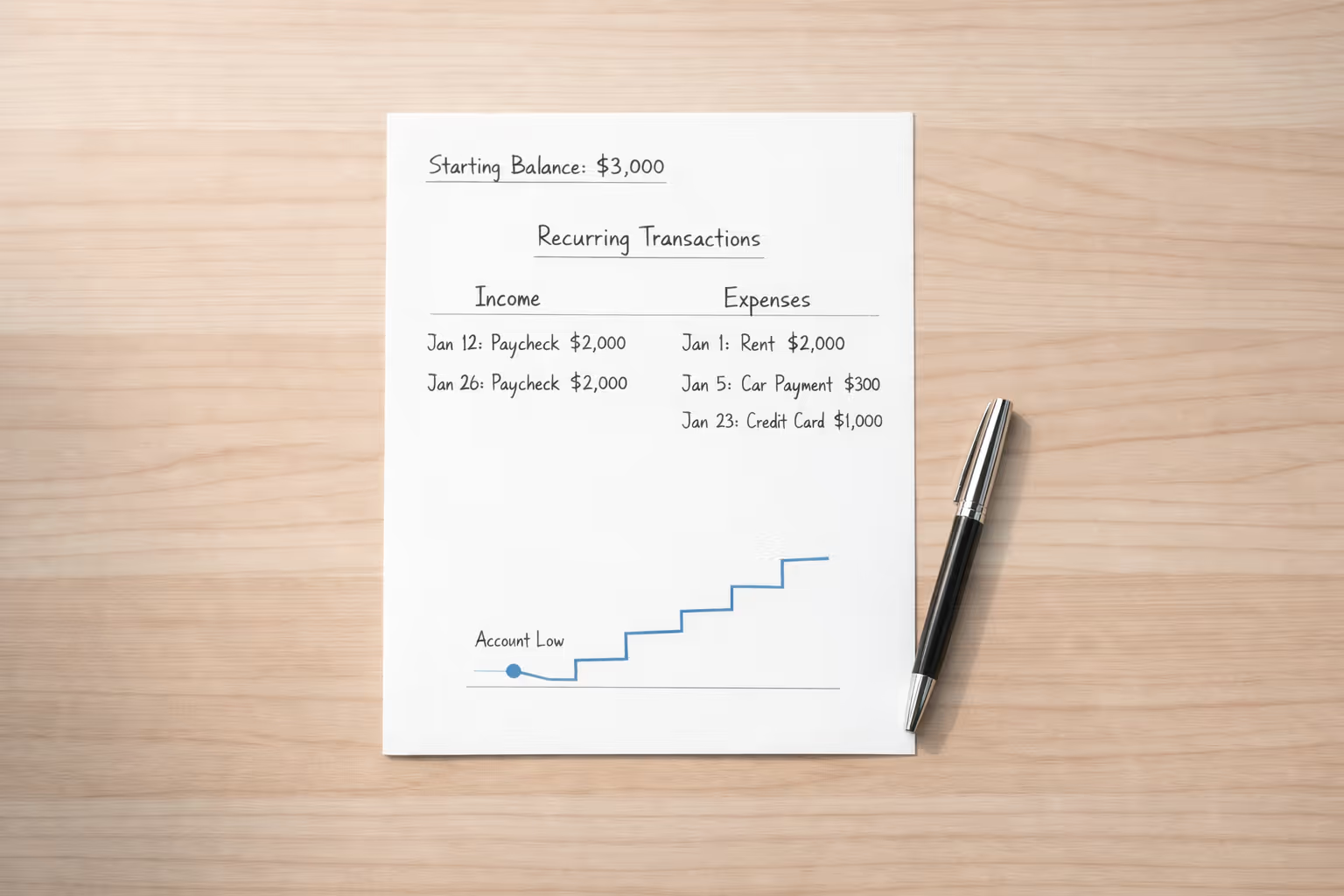
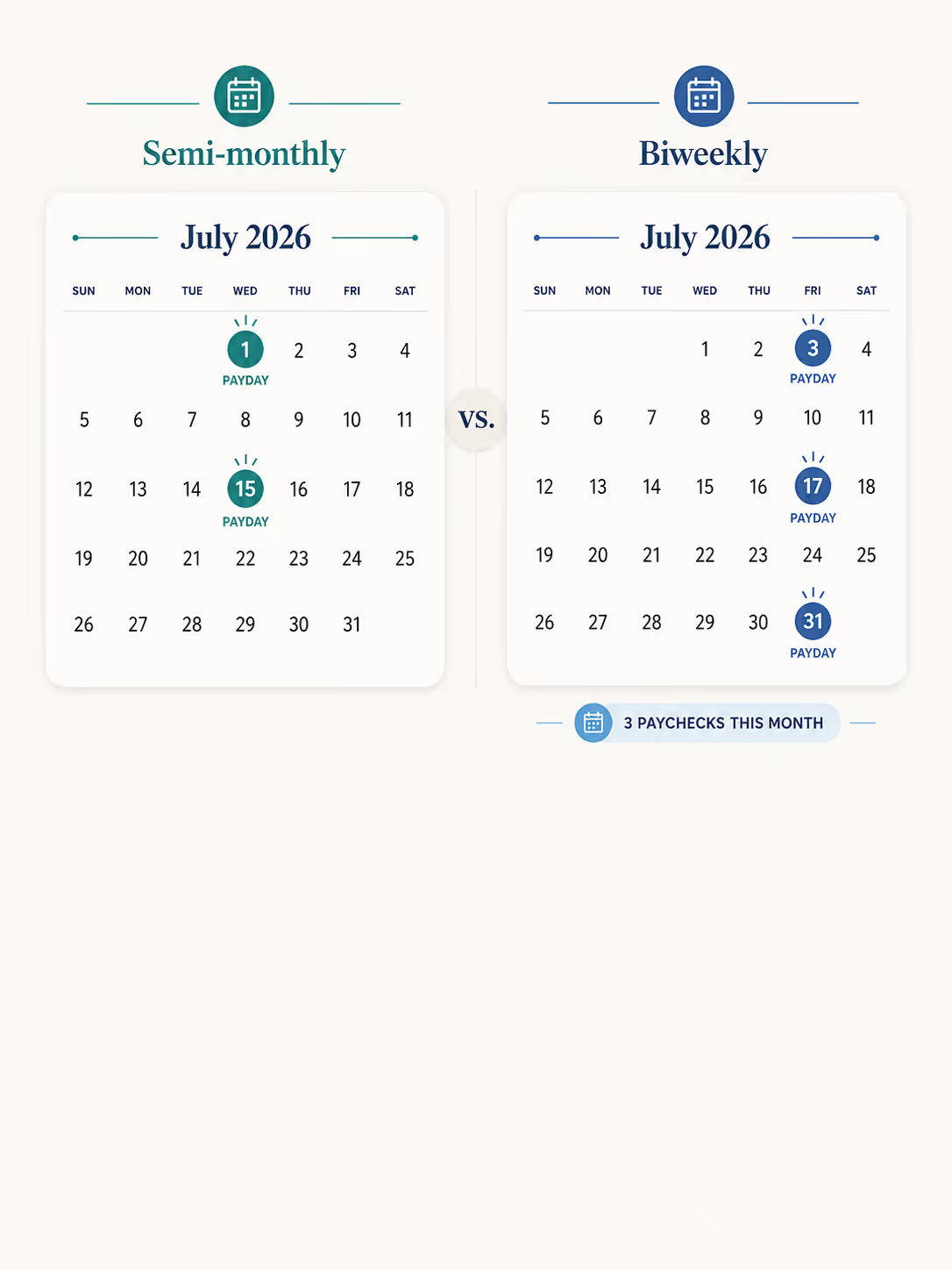
The second component is your scheduled cash flow—the income you expect to receive and the expenses you expect to pay over your planning window. This means capturing both your recurring patterns like your paycheck every two weeks, your rent on the first, and your car payment on the tenth, plus any one-time events you know are coming such as a tax refund. The completeness and accuracy of this component determines how well your forecast matches reality. Miss a recurring bill and your forecast will show more available cash than you actually have. Get the timing wrong on a major expense and you might think you're safe when you're actually headed for trouble.
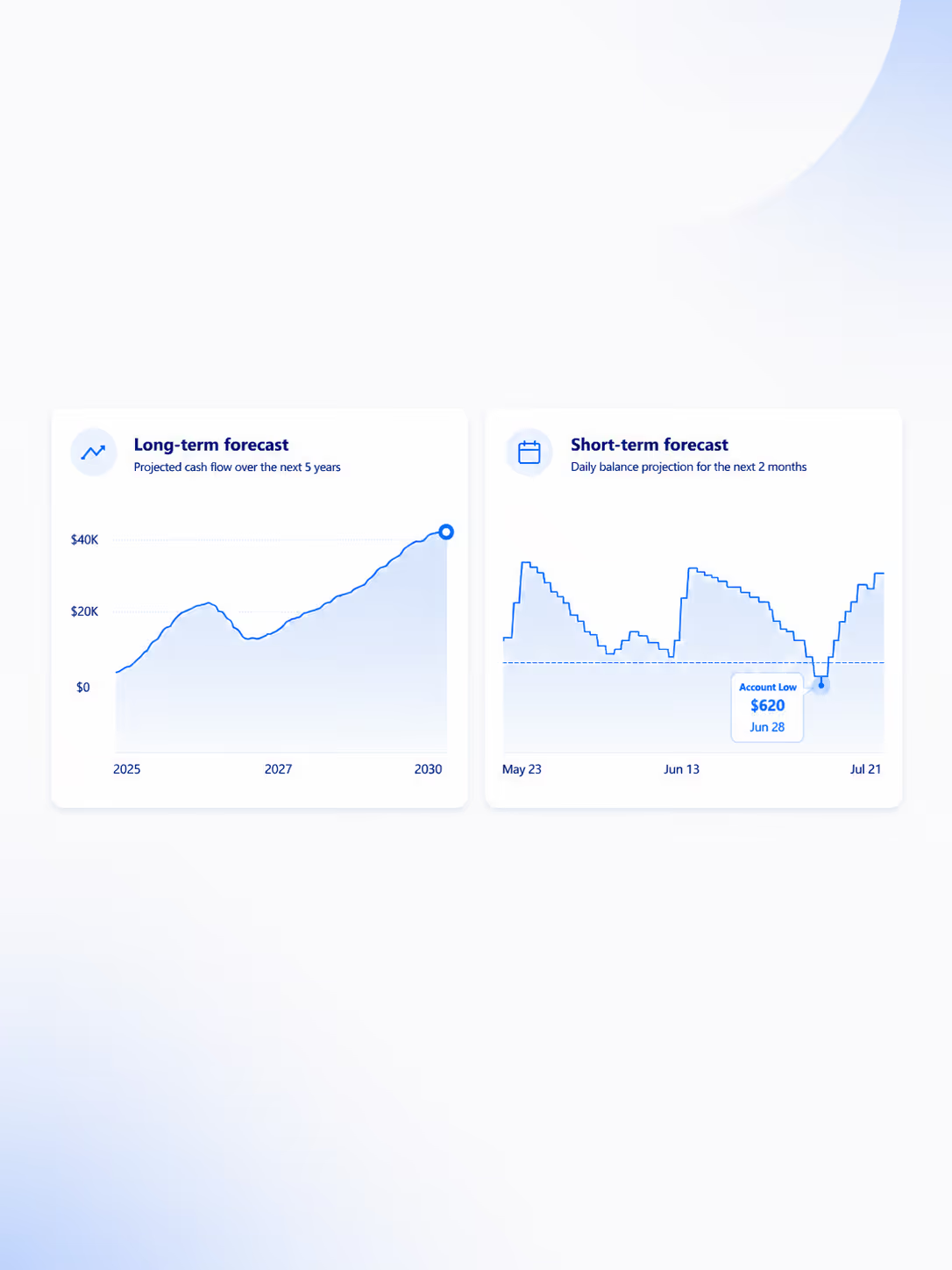
The third component is your planning window—how far forward your forecast should look. This is a meaningful decision because it involves a tradeoff similar to weather forecasting. Longer windows give you more visibility into what's coming, but accuracy naturally decreases the further out you forecast because life changes and circumstances shift. It's the same principle that makes a 3-day weather forecast more reliable than a 30-day forecast. Shorter windows are more accurate but give you less advance warning of problems or opportunities. Most effective forecasts use a planning window between 30 and 90 days, with sixty days offering a good balance between visibility and reliability—far enough to spot most issues before they occur, recent enough that your projections stay reasonably accurate. Centinel uses a 60-day window for this reason, though different tools may make different choices about the optimal horizon.
With these three components in place—your current balance, your scheduled cash flow, and your planning window—you have the raw materials needed to project your balance forward. Now let's walk through how to actually build that forecast step by step.
Creating an accurate checking account forecast follows a systematic process. This is how you'd build one, moving from the simplest elements to the more complex considerations that make your forecast reliable and actionable.
Start with the simplest piece: find your current checking account balance. Log into your bank and note exactly what your balance is right now. This becomes your starting point—the baseline from which your forecast projects forward. Write down not just the number but also the date and time you captured it, because this starting point will need to be updated periodically to keep your forecast accurate.
This might seem trivially simple, but that simplicity is deceptive. Your current balance is the anchor for everything else in your forecast, which means it needs to be precise. Don't use a rounded number or an estimate from memory. Don't use yesterday's balance unless you're certain nothing has posted since then. The actual balance showing in your account right now is what matters, because that's the real foundation your forecast will build on.
This step requires the most effort initially, but it's also the most important for forecast accuracy. You need to write out every recurring pattern of money moving in and out of your account. For each recurring event, you need to capture five specific pieces of information: the name or description so you know what it is, whether it's income or an expense, the anchor date when it occurs, the frequency it repeats, and the amount.
The best way to build this list is to look backward before projecting forward. Pull up your last 30-60 days of checking account transactions and work through them systematically. Your paycheck that arrives every other Friday. Your rent or mortgage on the first. Your car payment, utility bills, credit card payments, etc. Everything that repeats with any regularity needs to be captured here. You're essentially creating a catalog of your financial obligations and income sources as they actually exist in your checking account.
As you work through your transaction history, pay special attention to items that recur but not monthly. These are the ones that cause problems most often because they're easy to forget when you're thinking about your regular expenses. That quarterly car insurance payment. Your annual property tax bill. Your HOA dues that bill every three months. These items are particularly dangerous because they're usually larger amounts that can create significant cash flow problems if you haven't planned for them. A $45 monthly subscription that you forgot about might not derail your finances, but a $2,000 annual tax payment definitely can.
This identification process is time-consuming when done manually, which is why tools like Centinel include recurring transaction detection during onboarding. The system analyzes your recent transaction history and suggests patterns it identifies—your biweekly paycheck, your monthly rent, your monthly utility bills. This doesn't eliminate the need for your review because the system might miss something or misidentify a pattern, but it significantly reduces the manual work of going through transactions line by line. Instead of building the entire list from scratch, you're reviewing and confirming what the system found, then filling in any gaps. What might take an hour of careful manual analysis might take 5-10 minutes when you're working with suggested patterns that you're just verifying and refining.
Beyond your recurring patterns, think through any one-time transactions you know are coming within your planning window. That tax refund you're expecting next month. The wedding gift you need to send for your friend's ceremony in three weeks. Your annual bonus that arrives in December. These one-time events layer on top of your recurring patterns to give you a complete picture of what's scheduled to happen.
The Floor represents your personal comfort threshold—the minimum balance you want to maintain in your checking account even if the forecast shows you'll technically stay positive. Some people set their Floor at zero, meaning they're only concerned with avoiding actual overdrafts. Others set it higher—maybe at $500 or $1,000—because they want that buffer for peace of mind or unexpected expenses.
Your Floor serves two distinct purposes in your forecast. First, it acts as an early warning threshold. Even if your forecast shows you'll stay above zero, seeing that you'll dip below your Floor tells you that you're cutting it closer than you're comfortable with. It's like the difference between a fuel gauge showing empty versus showing a quarter tank—technically you're not out of gas at a quarter tank, but you might want to fill up anyway because you don't want to be running on fumes. Your Floor creates that same kind of advance warning for your checking account.
Second, your Floor becomes essential for optimization decisions. Your Floor is where your comfort zone begins, so anything above it represents margin you can potentially work with.
Setting your Floor is a personal decision based on your risk tolerance and financial situation. Someone with stable income, predictable expenses, and easy access to emergency funds might be comfortable with a lower Floor. They know that if something unexpected happens, they have other resources to draw on. Someone with variable income, a history of unexpected expenses, or limited backup options might want a higher Floor for security. They need more buffer in their checking account because they don't have the same safety net elsewhere. There's no universally correct Floor—it's about understanding your own financial situation and risk tolerance and setting a threshold that lets you sleep soundly at night.
Now your forecast needs to do the mathematical work: simulate forward day by day, track your running balance, identify when you'd cross zero or your Floor, and calculate your Account Low—your projected minimum balance across the entire planning window.
This is the computational engine of forecasting. The engine starts with your current balance and walks through each day of your planning window, adding income when it arrives and subtracting expenses when they withdraw. As it simulates forward, it tracks several critical thresholds: whether you'll drop below zero at any point, whether you'll dip below your Floor, and most importantly, your Account Low—the projected lowest balance anywhere in your planning window.
Account Low is the single most actionable number your forecast produces because it answers the fundamental questions that matter most. If your Account Low is negative, you'll overdraft at some point during the forecast period, and the number tells you exactly how much you need to deposit to stay above zero throughout.
If your Account Low is positive, it reveals your absolute margin—money that's unspoken for by your scheduled obligations. This is where your Floor becomes valuable for optimization decisions. While your Account Low shows the lowest point you'll reach during your forecast period, many people don't want to operate right at that edge. The relationship between these two numbers determines what you can safely deploy: Available Cash = Account Low - Floor. If your Account Low is $1,000 and your Floor is $500, you have $500 you could deploy to savings, investments, or debt paydown while still maintaining $500 in your account throughout the forecast period. This is the margin you can work with while staying above your comfort threshold.
The simulation also handles an important technical detail called the posting order problem. Banks process transactions in batches and have discretion over sequencing, which means if your rent and paycheck both post on the same day, the rent might process first and temporarily push you negative even though you have enough money to cover everything. Conservative forecasts address this by assuming debits always post before credits on the same day, which protects you from unexpected overdraft fees and makes your Account Low a more reliable number for decision-making.
You can build this computational engine yourself in a spreadsheet if you're comfortable with formulas and logic, but this is precisely the kind of repetitive calculation that tools exist to handle. Centinel, for example, has this entire calculation engine already built. You provide the inputs from Steps one through four, and the system handles the computational work instantly, recalculating your entire forecast every time you add or adjust a transaction.
For a deeper understanding of how Account Low is calculated, why it uses conservative assumptions, and how to interpret it for both safety and optimization decisions, see our complete guide on understanding your projected minimum balance.
Once you understand how the computational engine works, you're ready for the final setup step: validating your forecast's accuracy.
Once your forecast is built and calculating, review what it's telling you. Does your projected balance evolution make sense given what you know about your cash flow patterns? Are you identifying an Account Low that aligns with your intuition about your tightest cash moment? This review step helps you catch any recurring events you might have missed or amounts that might need adjustment.
Walk through the timeline and verify that major events appear when you expect them. Your paycheck should show up on the right dates. Your rent should withdraw on the first. Your car payment should hit on the tenth. If something looks off—if your projected balance dips unexpectedly or spikes in ways you don't recognize—trace backward to see whether you missed a transaction, entered the wrong amount, or got the timing incorrect.
This review is also where you validate that your recurring event identification was complete. If your forecast shows plenty of surplus but you know intuitively that you usually run tighter than that, you've probably missed something. The forecast can only work with what you've told it, so any gaps in your input data will show up as overly optimistic projections.
The good news is that you can refine as you go. Build the initial forecast with the information you have, review it for obvious problems, make corrections, and then let real-world feedback improve accuracy over time. When a transaction posts that you didn't have in your forecast, you add it for next time. When an amount turns out to be different than you estimated, you adjust it.
Creating a forecast isn't a one-time event—it's an ongoing practice. Your forecast stays accurate only if you keep it current as things change. This means two specific maintenance activities that need to happen regularly, each addressing a different type of drift between your forecast and reality.
Remember that your forecast projects forward from your current balance as of a specific moment. As days pass and new transactions post to your account, that starting point becomes outdated. If you built your forecast on January 1st showing a balance of $3,000, but it's now January 7th and your balance is actually $2,000 because several bills have posted, your forecast is projecting from the wrong foundation. Everything it shows you about the future is shifted upward by $1,000, which means you're seeing a more optimistic picture than reality supports.
If you built your forecast manually, this means logging back into your bank and updating the current balance figure every few days or at least weekly. Each time you update it, you're giving your forecast a fresh foundation to project from. The more frequently you update, the more accurate your forward projections remain. If you're using Centinel's automated tier, this happens without your intervention—your balance updates automatically every day by pulling directly from your bank, which means your forecast always projects from the most current starting point without you needing to remember to check.
Frequent balance updates serve another critical purpose beyond just keeping your starting point fresh: they act as a reality check on your forecast's accuracy. When you update your balance, you're not just replacing one number with another - you're comparing what your forecast predicted your balance should be against what your bank says it actually is. If those numbers diverge significantly, that divergence tells you something in your forecast is wrong and needs investigation. Maybe you projected your paycheck would be $1,000, but when you check your balance after it posts, you discover it was only $750 because of a tax withholding you forgot about. You only discover these forecast errors by regularly comparing your projected balance to your actual balance. The more frequently you check, the sooner you catch discrepancies and can investigate what went wrong.
This is where Centinel's daily automatic balance updates provide value beyond just convenience. Because the system pulls your actual balance every day, it's constantly checking whether reality matches your forecast. If your actual balance is significantly different from what the forecast predicted, you know immediately that something needs investigation - either you missed adding a transaction, projected an amount incorrectly, or something you expected didn't happen. With manual updates, you only catch these discrepancies when you remember to log in and check, which might be days or weeks later when the error has compounded and become harder to trace back to its source.
Your forecast is only as good as the scheduled income and expenses you've told it about, and those numbers change in two distinct ways that both require your attention.
First, there's the regular variance in amounts you already know are coming. When your credit card statement closes and you know exactly what this month's payment will be, update that amount in your forecast. When your electricity bill arrives and it's higher than expected because it was an unusually hot month, adjust your projected utility costs for next month. When you see your paycheck stub and notice your net pay was slightly different than you expected because of a small tax withholding change, update your recurring paycheck amount. These are refinements to obligations and income sources that already exist in your forecast—you're just getting more precise about the actual amounts as that information becomes available.
Second, there are structural changes to your financial patterns themselves. You get a raise and your net paycheck permanently increases. Your rent goes up when your lease renews. You take on a new car loan payment that didn't exist before. These aren't refinements to existing items—they're permanent additions, deletions, or modifications to your recurring cash flow that shift your entire forecast picture going forward.
Both types of updates matter equally for forecast accuracy. The first type happens more frequently and is generally reactive—you learn something new and update the forecast to reflect it. Some of this routine updating can be automated if you're using the right tools. Centinel's paid tier includes credit card statement tracking that automatically pulls new statements when they post, updating your scheduled credit card payment amounts without requiring manual entry. This eliminates one of the most common sources of forecast drift: credit card balances that vary month to month.
The second type of update—when your financial structure changes—always requires your active involvement because only you know when these life changes occur. No automated system can know you just negotiated a raise or decided to cancel a subscription. The system can see that your paycheck amount changed after it posts, but you'll get more accurate forecasts if you update it proactively when you know a change is coming rather than waiting to see it reflected in your posted transactions.
This two-level maintenance structure is where the real tradeoff between manual and automated approaches becomes apparent. In a manual system, you're responsible for every update—checking your balance, pulling new statements, entering changes. It's entirely doable, and many people successfully maintain manual forecasts, but it requires consistent discipline. You have to remember to update your balance regularly, watch for new credit card statements, and adjust amounts as they change. The work isn't complicated, but it's ongoing, and if you let it slide for a week or two, your forecast accuracy degrades quickly.
The challenge with manual maintenance goes beyond just the effort required. It's also about what you miss when updates are infrequent. When you only check your balance every few days or once a week, you're going longer without catching discrepancies between what your forecast predicted and what actually happened. That electric bill you forgot to add, that paycheck that came in lower than expected, that one-time expense you missed—these errors compound silently until you finally check and discover your forecast has been wrong for days. The longer the gap between updates, the harder it becomes to trace back what went wrong and when.
Automated systems like Centinel's paid tier handle the routine data-gathering work in the background and provide continuous reality checking. Your balance refreshes daily automatically, which means the system is comparing your forecast to actual reality every single day. Credit card statements pull in when they close, keeping your variable payment amounts current without manual tracking. When discrepancies appear between your forecast and your actual balance, you discover them within twenty-four hours rather than days or weeks later, which makes it much easier to identify what caused the gap and fix it. On top of this, the system can send you alerts when your forecast shows you're approaching zero or your Floor.
You're still responsible for the things only you can know—reviewing accuracy, adding one-time expenses you've scheduled, updating when you make life changes—but the mechanical work of keeping your starting balance current, tracking your credit card obligations, and catching forecast errors early happens automatically. This shifts your maintenance work from routine data entry and error detection to higher-level oversight: reviewing the forecast periodically to ensure it still reflects your reality and making adjustments when your circumstances change.
The maintenance question isn't whether you need to keep your forecast current—you do, regardless of approach. The question is where you want to spend your time and attention. Manual maintenance means more ongoing work but complete control and no ongoing cost—use Centinel's free tier for that. Automated maintenance means less routine work, reduced likelihood of human error, and faster error detection through daily reality checks, but reliance on system integrations and a subscription cost—use Centinel's premium tier for this. Both can produce accurate forecasts if maintained properly.
Creating a checking account forecast transforms your relationship with your money by replacing uncertainty with clarity. By understanding what components a forecast requires, following a systematic process to capture your cash flow patterns, building or using a computational engine to project forward, and maintaining your forecast as things change, you create a tool that continuously answers the questions that used to create anxiety: Am I actually safe right now? Can I afford to move money to savings? Do I need to do something, and if so, by when?
The forecast you've created becomes your financial visibility system—showing you not just where you are, but where you're headed and what margin you have to work with. Whether you've built this manually or you're using a tool like Centinel to handle the computational complexity, the core principle remains the same: managing your checking account effectively requires seeing your full cash flow picture, not just a single moment in time. That forward-looking visibility is what turns reactive balance-checking into proactive cash flow management, giving you the information you need to make confident decisions about your money instead of constantly wondering whether you're safe or how much you can really afford to use.
STAY A STEP AHEAD