Analysis
10
min.

The Real Cost of Overdraft Fees in America

Americans paid $12.1 billion in overdraft fees in 2024. Here's who pays the most and what the data reveals about how to stop the cycle.

March 6, 2026

Woman staring down at papers strewn across her kitchen table, visibly stressed about budgeting.

Americans paid an estimated $12.1 billion in overdraft and nonsufficient funds (NSF) fees in 2024. That number is higher than previously thought—new credit union reporting data revealed that earlier estimates were understating the problem by nearly $4 billion per year. Even after a significant decline from pre-pandemic levels, overdraft fees remain one of the largest drains on household finances in the United States.

Here's what the latest data shows: The average overdraft fee is $26.77 in 2025. Roughly 11% of banked adults paid at least one overdraft fee in 2024. And a small fraction of accounts—about 9%—generate nearly 80% of all overdraft revenue. That concentration is the key to understanding why overdraft fees persist and who they actually affect.

This article breaks down the numbers, examines who pays the most, and looks at what the data reveals about why overdrafts keep happening—and why the answer is more nuanced than most financial advice suggests.

How Much Americans Pay in Overdraft Fees Each Year

For years, the standard estimate of total overdraft and NSF fee revenue came from bank call report data collected by the FDIC. Banks with over $1 billion in assets have been required to report this revenue since 2015, and from 2015 through 2019, the total was remarkably consistent: $11–12 billion per year.

Then came a meaningful decline. Pandemic stimulus checks temporarily pushed up account balances, and starting in late 2021, several major banks voluntarily reduced or restructured their overdraft programs. By 2023, reported bank overdraft/NSF revenue had fallen to $5.8 billion—a drop of more than 50% from pre-pandemic levels. That was the good news, and it generated optimistic headlines.

The picture changed in late 2025 when the Financial Health Network published revised estimates using newly available credit union data. Beginning in 2024, the National Credit Union Administration required large credit unions to report overdraft and NSF fee revenue for the first time. When those numbers were factored in, the total jumped significantly: $11.8 billion in 2023 and $12.1 billion in 2024, compared to the previous 2023 estimate of $7.9 billion. The earlier models, built without comprehensive credit union data, had been understating the burden by roughly $4 billion per year.

In other words, the decline was real but smaller than the headlines suggested. Overdraft fees didn't fall by half—they fell by a meaningful amount at the largest banks while remaining substantial across the broader financial system. And more recently, the trend may be reversing: several large banks reported year-over-year increases in overdraft fee income through the first three quarters of 2025.

Who Pays the Most—and Why It's Not Random

The aggregate number is striking, but the distribution is what matters. Overdraft fees don't spread evenly across the population. They concentrate—heavily—among a specific group of accounts and a specific set of demographics.

Start with the concentration. According to CFPB data, roughly 9% of checking accounts are overdrawn 10 or more times per year, and those accounts generate approximately 79% of all overdraft and NSF fee revenue. The remaining 91% of accounts split the other 21%. This isn't a problem that affects everyone a little—it's a problem that affects a relatively small number of people a lot.

Now look at who those people are. The Federal Reserve's 2024 Survey of Household Economics and Decisionmaking (SHED) provides the demographic breakdown. Among banked adults who paid at least one overdraft fee in the prior 12 months, the incidence rates vary sharply by income, age, and race.

By income: 19% of adults earning $25,000–$49,999 paid an overdraft fee, compared to just 6% of those earning $100,000 or more. By age: 16% of adults aged 18–29 paid an overdraft fee, compared to 6% of those 60 and older. By race: 21% of Black Americans and 16% of Hispanic Americans paid an overdraft fee, compared to 9% of white Americans and 6% of Asian Americans.

These aren't independent patterns. They overlap and reinforce each other, pointing to a common underlying factor. The question is: what is that factor?

The conventional assumption is spending behavior—that people who overdraft are living beyond their means. And for some, that's genuinely part of the picture. But that explanation, on its own, leaves important questions unanswered. If these households simply can't afford their expenses, why does the pattern cycle rather than escalate? Why do the same accounts overdraft 10 or more times per year without closing or steadily accumulating debt? Something about the structure of how money moves—not just how much of it there is—appears to play a significant role.

Why Timing Matters More Than Most People Realize

To understand what's really happening, it helps to think about three different situations that can produce an overdraft.

In the first, someone earns enough to cover their expenses over the course of the month, but their paycheck arrives after a bill is due. The money was coming—it just wasn't there yet. This is a pure timing problem: the same income and the same expenses produce an overdraft or don't depending entirely on the calendar.

In the second, someone's income barely covers their expenses. The margin is thin enough that any timing mismatch—a paycheck a day late, an auto-pay hitting a day early—pushes them over. The underlying vulnerability is a tight budget, but the trigger that converts a tight month into an actual overdraft fee is timing.

In the third, someone genuinely doesn't earn enough to cover their expenses. They're going to come up short regardless of when anything hits. This is an income insufficiency problem, and no amount of timing optimization changes the fundamental math.

The conventional narrative treats most overdrafts as either the third case or as irresponsible spending. But the data suggests that the first and second cases—where timing is the mechanism that converts financial tightness into actual fees—account for a substantial share of what's happening. Here's the evidence.

The Cyclical Pattern

The 9% of accounts generating 79% of revenue aren't steadily accumulating debt until they close. They're cycling: overdraft, paycheck arrives, balance recovers, next bill cycle, overdraft again. That pattern—repeated 10 or more times per year—tells us something important: these households' income and expenses are close enough that the balance recovers each pay period. If income genuinely couldn't cover expenses at all, the balance would trend downward until the bank eventually charged off and closed the account. But for the majority who keep cycling, the money is arriving. The question is whether it's arriving with enough margin and at the right time to clear each bill before a fee is triggered.

The Demographic Correlation

Lower-income households have thinner buffers to absorb timing gaps. Younger workers are more likely to be in hourly or variable-schedule jobs with less predictable pay timing. These demographics correlate with both income tightness and timing vulnerability—but the fact that the overdraft pattern is cyclical rather than terminal points to timing as the proximate cause.

The Posting Order Effect

The posting order problem provides direct mechanical evidence that timing drives fee outcomes. While many banks have moved away from the controversial practice of processing debits largest-to-smallest, same-day timing uncertainty remains. When a deposit and a payment are both scheduled for the same day, you can't always predict which will post first — it depends on your bank's batch processing schedule, when each transaction file arrives, and cutoff times that vary by institution and transaction type. Two people with identical balances, identical income, and identical bills can end up with different fee outcomes based purely on when and in what order their transactions happen to post. That's timing, not spending — and it affects everyone regardless of income level.

The Biweekly Pay Problem

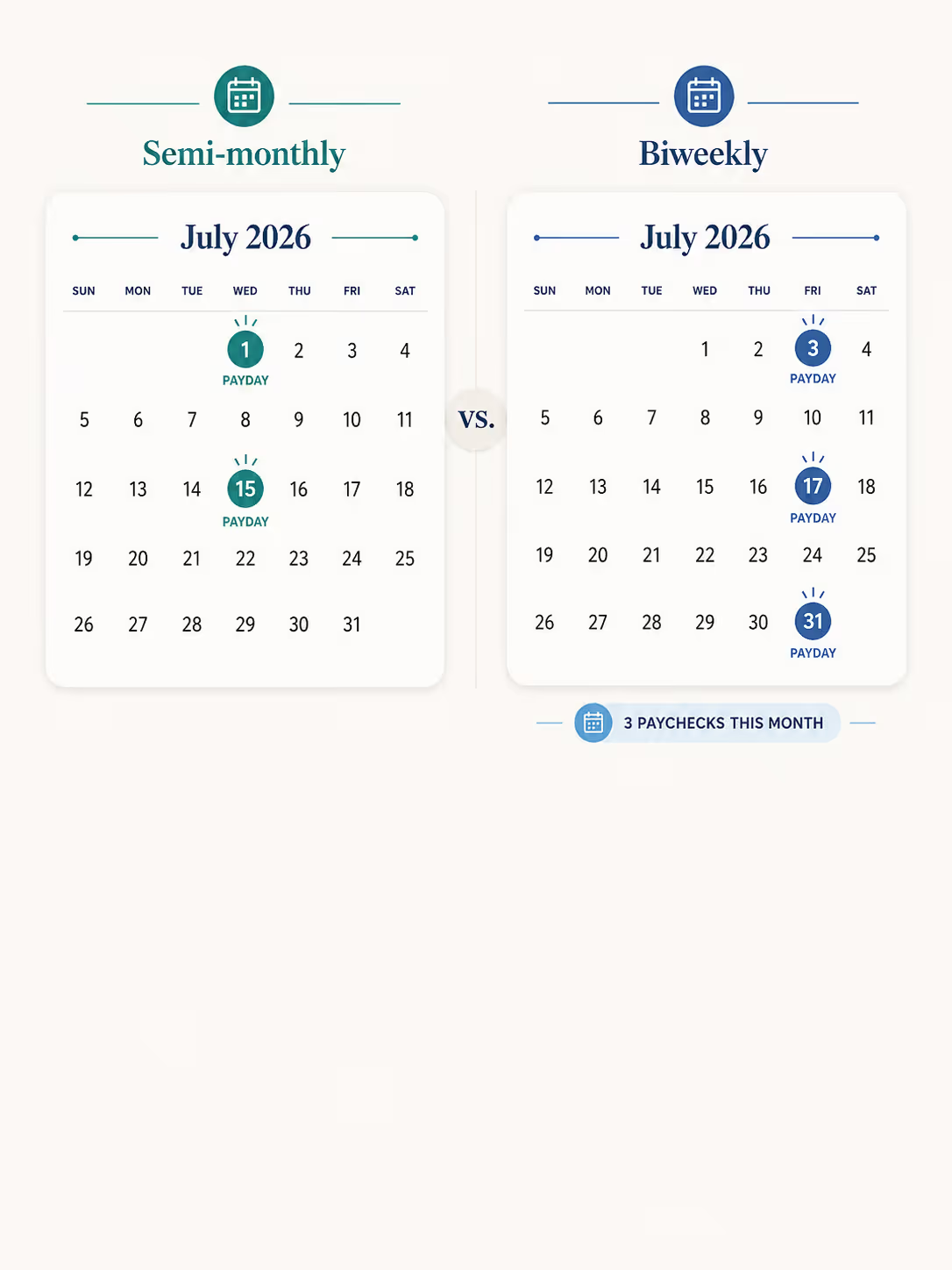
If you're paid biweekly, the timing challenge is structural. Your bills are anchored to calendar dates — rent on the 1st, car payment on the 4th, credit card on the 19th. Your paychecks are anchored to weekdays — every other Friday, on a strict 14-day cycle that doesn't care about the calendar. Because these two rhythms never sync up, the mapping between "this paycheck" and "these bills" shifts every month. One month, your first paycheck covers rent and a car payment. The next month, that same paycheck might need to cover rent, a car payment, and a credit card bill that slid into its window. The bills didn't change. The pay didn't change. But which paycheck is responsible for what quietly shifted — and with it, whether each paycheck is actually sufficient to cover its new assignment.

How Overdraft Fees Compound Into a Bigger Problem

The concentration pattern—9% of accounts generating 79% of revenue—isn't just a statistical curiosity. It reflects the same cascading dynamic that makes overdraft fees so destructive: once you overdraft, the math works against you

An overdraft fee reduces your already-low balance further, making subsequent transactions more likely to overdraft too. A household with $80 in checking that gets hit with one $26.77 fee now has $53.23. Transactions that would have cleared at $80 suddenly won't clear at $53.23. A second fee brings the balance to $26.46. A third makes it negative. What started as a single timing gap has cascaded into three fees totaling $80.31—more than the original balance.

This cascade effect explains the concentration. It's not that 9% of account holders are uniquely careless. It's that the fee structure creates a feedback loop: the first overdraft makes the second more likely, and the second makes the third almost inevitable for anyone operating on thin margins. The same household, with the same income and expenses, could avoid all three fees if their paycheck posted one day earlier—or if they had visibility into the shortfall before it arrived.

Data supports this: households that pay frequent overdraft fees tend to hold checking balances under $500, and roughly 81% of those who were charged overdraft fees also struggled with bill payments more broadly. These are people managing tight cash flow, not people ignoring their finances. In many cases, they're acutely aware of every dollar—they just can't see far enough ahead to prevent the gap.

Are Overdraft Fees Going Away?

The short answer: not anytime soon.

The decline from 2019 to 2023 was driven primarily by voluntary policy changes at the largest banks—eliminating NSF fees, adding grace periods, waiving small-dollar overdrafts. These are all forms of overdraft protection rather than overdraft prevention—they soften the blow when an overdraft occurs but don't help you see one coming. But as the CFPB noted, that decline leveled off across all four quarters of 2023, suggesting the major policy shifts have run their course. The easy reductions have been made.

On the regulatory side, the CFPB finalized a rule in December 2024 that would have capped overdraft fees at $5 for large banks. Congress overturned the rule before it took effect, and under the Congressional Review Act, the CFPB cannot issue a substantially similar rule without new legislation.

Meanwhile, some banks are seeing fee income tick back up. JPMorgan reported a 7.7% year-over-year increase in overdraft fee income through the first nine months of 2025. Citizens Financial reported a 16.9% increase over the same period. Economic pressure on consumers—rising prices, variable income, thin savings—appears to be pushing more people back into overdraft territory.

The system that produces overdraft fees—fixed bill dates, variable income timing, low-balance accounts with per-incident charges—remains structurally unchanged. Individual banks have softened the edges, but the underlying dynamics are the same ones they've always been. Which means the solution, for most people, won't come from waiting for banks or regulators to fix it.

What the Data Points To

The data in this article doesn't tell a simple story. Some people who overdraft are genuinely stretched beyond their income. Others earn enough over the course of the month but get caught by calendar mismatches. Most are probably somewhere in between—tight margins made worse by timing gaps they can't see coming.

But here's what the data does make clear: regardless of the underlying cause, timing is the mechanism that determines whether a tight month produces zero fees, one fee, or three. Two people with identical income and identical expenses can pay vastly different amounts in overdraft fees depending on when their transactions post. The posting order, the pay schedule, the bill due dates—these timing factors are what convert financial tightness into actual charges. And they're the part of the equation that's most preventable.

How Forecasting Breaks the Cycle

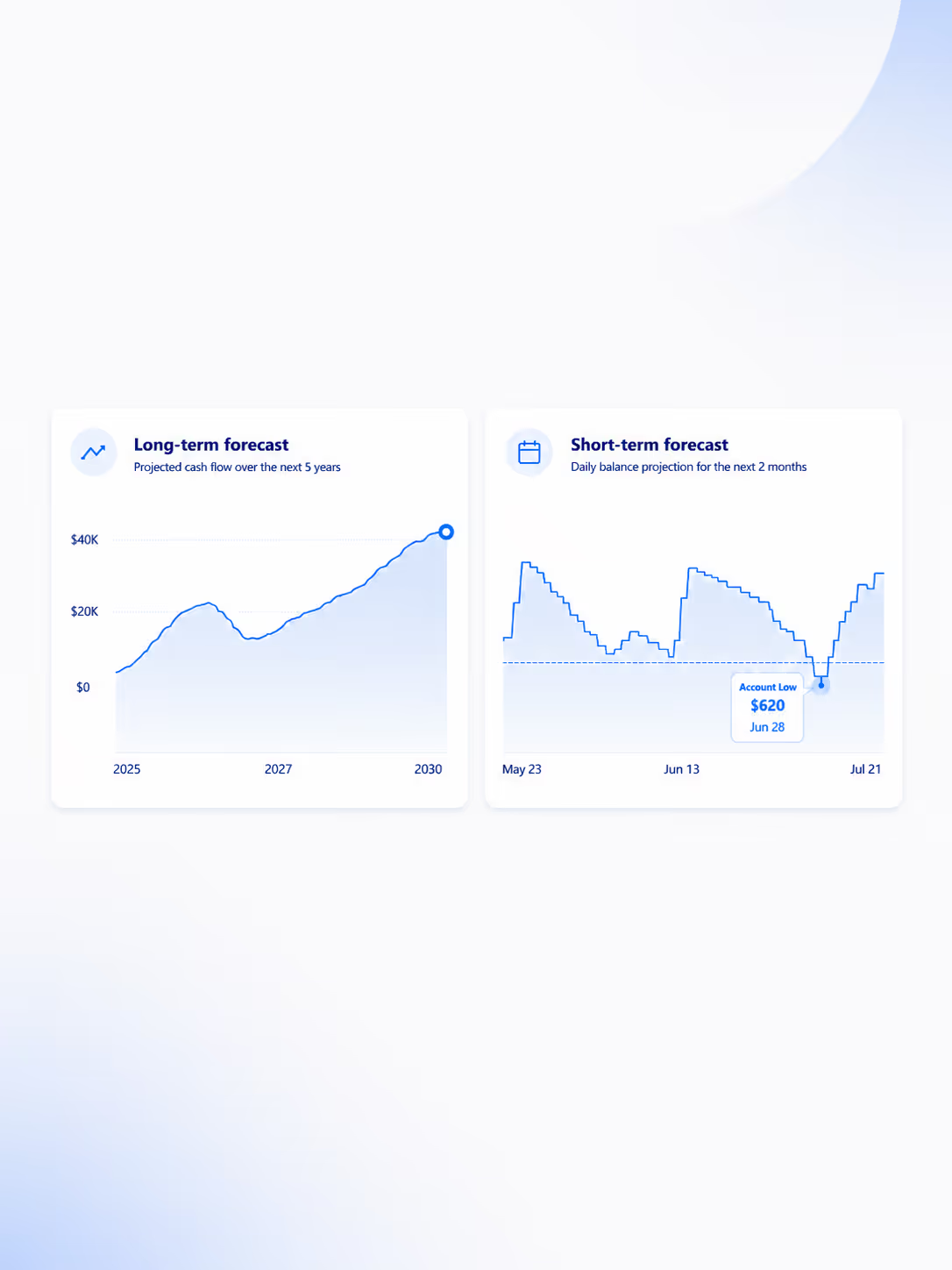
If timing is the mechanism, then the most effective intervention isn't a budget that tells you what you spent last month. It's a checking account cash flow forecast that shows you what's coming next month—a day-by-day view of when your balance will rise and fall, so you can see the gap before it becomes a fee.

The value of forecasting scales across the full spectrum of financial situations described in this article. For someone whose income comfortably covers their expenses, a forecast catches the occasional calendar misalignment before it triggers a fee—the paycheck that arrives a day after rent posts, the auto-pay that hits during a low-balance window. For someone on tight margins, a forecast provides enough lead time to predict and prevent the overdraft before it happens: move a bill due date, transfer a small amount from savings, or hold off on a discretionary purchase until after payday. Even for someone who's genuinely short, seeing the shortfall days in advance means managing one controlled gap instead of being blindsided by a cascade of three fees.

The Bottom Line

Overdraft fees remain a $12 billion annual burden, concentrated among the households who can least afford them. The data shows that the same accounts get hit repeatedly — not because the people behind them are careless, but because tight margins and misaligned timing create a cycle that's hard to break without forward visibility into what's coming next.

Centinel is built to provide that visibility. It forecasts your checking account balance 60 days forward, showing you day by day when your balance will dip and when it will recover. When your projected balance approaches your Floor — the minimum you've set for your account — you see it in advance, with time to act. No spreadsheets, no guesswork, and no waiting for a fee to tell you what went wrong. Join the waitlist for early access.

This article is for informational purposes and does not constitute financial advice. Data cited reflects the most recent publicly available figures at the time of publication. Individual circumstances vary.

More Resources

STAY A STEP AHEAD

Limited Early Access.

Join the waitlist for priority access to Centinel’s launch and get invited to test features before the general public.