U.S. households hold $4.5 trillion in checking accounts earning almost nothing. We calculated the cost—and it's tens of billions per year. Here's the breakdown.
January 26, 2026
American households are collectively leaving tens of billions of dollars on the table every year — not through bad investments or excessive spending, but through something far more mundane: keeping too much money in their checking accounts.
According to Federal Reserve data, U.S. households hold approximately $4.5 trillion in checkable deposits and currency. The vast majority of that money earns almost nothing. The national average interest rate for checking accounts is just 0.07% APY, according to the FDIC. Meanwhile, high-yield savings accounts — equally safe, equally liquid, equally FDIC-insured — are paying 4% or more.
The difference between 0.07% and 4% might not sound dramatic, but applied to trillions of dollars it adds up to a staggering sum. And for individual households, the cost compounds over years and decades into real money that could have been working for them.
This isn't money lost to market downturns or risky bets. It's money lost to inertia — to the simple act of leaving cash sitting in an account where it doesn't need to be.
Before the numbers, a note on methodology. Estimating the hidden cost of excess checking balances requires an assumption about how much of that $4.5 trillion is genuinely needed for day-to-day cash flow versus how much is sitting idle.
We drew on three authoritative sources. First, the Federal Reserve's Financial Accounts report household checkable deposits and currency at roughly $4.5 trillion as of Q3 2025. (The Q4 2025 release shows this figure jumping above $5.6 trillion, but the Federal Reserve attributes that to a single large bank reclassifying savings accounts as transaction accounts when it wound down its retail sweep program — an accounting change, not real cash moving into checking. We use the pre-reclassification figure as the truer measure of idle checking balances.) Second, the Bureau of Labor Statistics Consumer Expenditure Survey reports average annual household expenditures of $78,535 in 2024, or roughly $6,545 per month. Third, the FDIC's National Rates publishes the average checking interest rate — currently 0.07%.
Not all money in checking is "excess." Households need a certain amount readily available to cover the timing gap between when bills hit and when income arrives. The question is how much is genuinely needed versus simply parked out of habit or fear.
We used a framework based on what treasury professionals call a target minimum balance — or what we'll call a Floor. The Floor is the core of how much money to keep in your checking account: a reasonable Floor for most households is one to two weeks of essential expenses, enough to absorb the natural timing mismatch in cash flow without keeping excessive amounts idle. Based on average monthly expenditures of $6,545, that's roughly $1,600–$3,300. We used $2,500 as a midpoint — a conservative figure, since it's based on total expenditures rather than just essentials.
Because reasonable people can disagree about how much households genuinely need, we present three scenarios:
These present a range rather than false precision.
With $4.5 trillion in household checking accounts and an interest-rate differential of roughly 3.93% (4.00% for high-yield savings minus 0.07% for checking), the aggregate opportunity cost depends on how much of that total is truly excess.
Even under the most conservative assumptions, American households are collectively forgoing roughly $44 billion per year in interest by keeping excess cash in checking rather than high-yield savings. Under moderate assumptions, the figure rises to $70 billion per year — roughly $520 per household, on average. That's money lost not to fraud or bad luck, but to cash sitting in the wrong type of account.
Aggregate numbers are striking, but what matters is the household level. The math is straightforward: for every dollar you keep in checking beyond what you need, you earn 0.07% instead of 4% — a difference of roughly 4 cents per dollar per year. Applied to thousands of dollars over many years, it becomes significant.
If you're keeping $10,000 more in checking than you need for cash flow, you're giving up about $400 a year — money that requires no additional work, no risk, and no lifestyle change, just a transfer from one FDIC-insured account to another.
The hard part is knowing how much you actually need in checking. Most people suspect they have too much but don't know what's safe to move — so they move nothing.
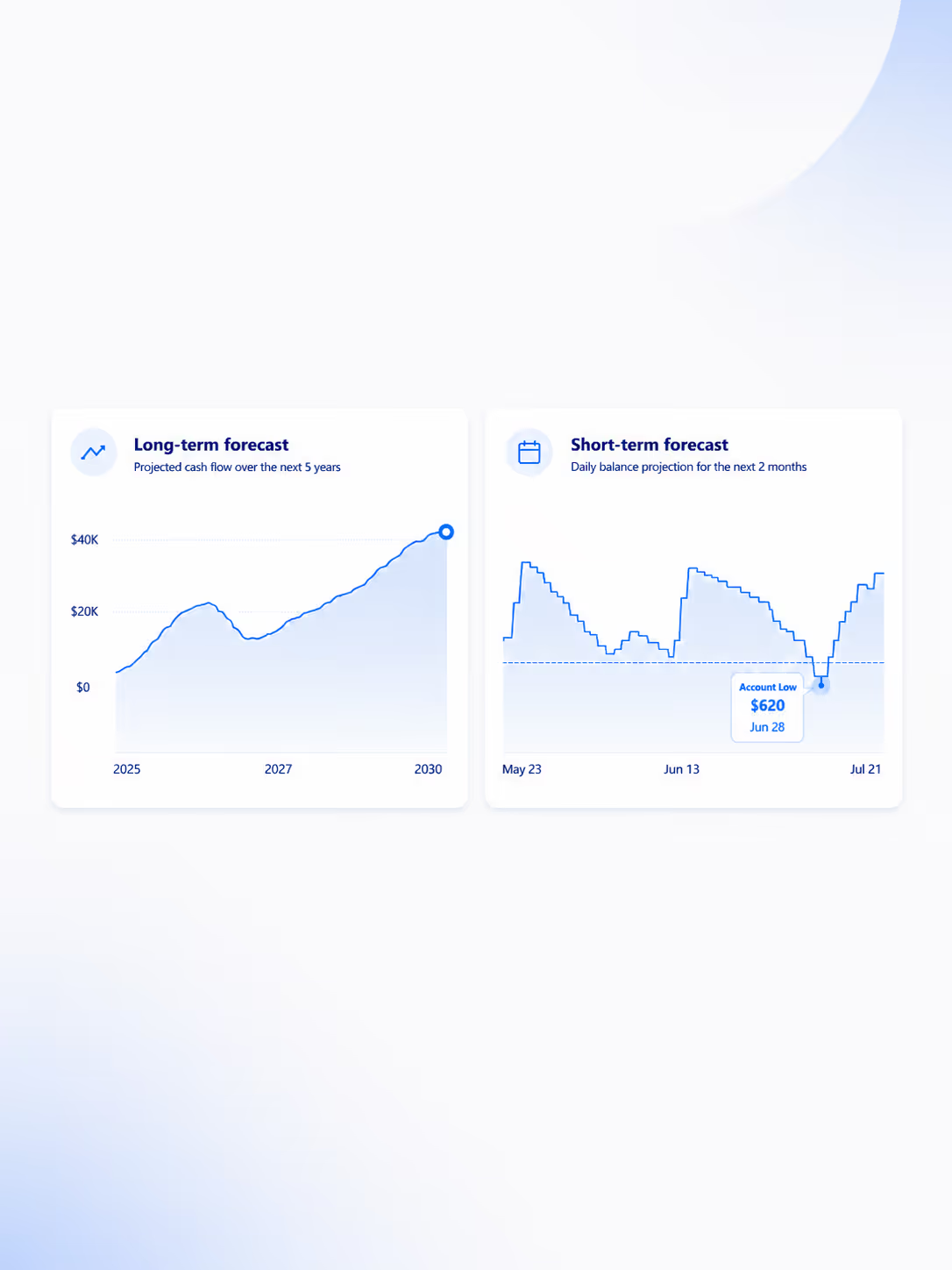
The answer is checking account cash flow forecasting. You project your balance forward over the next 2 months, find its lowest point, and subtract the minimum you want to keep on hand; the remainder is excess: Available Cash = Account Low − Floor. This is the method behind determining what's safe to spend in your checking account. It's the only reliable way to separate the cash you need from the cash that's just sitting there.
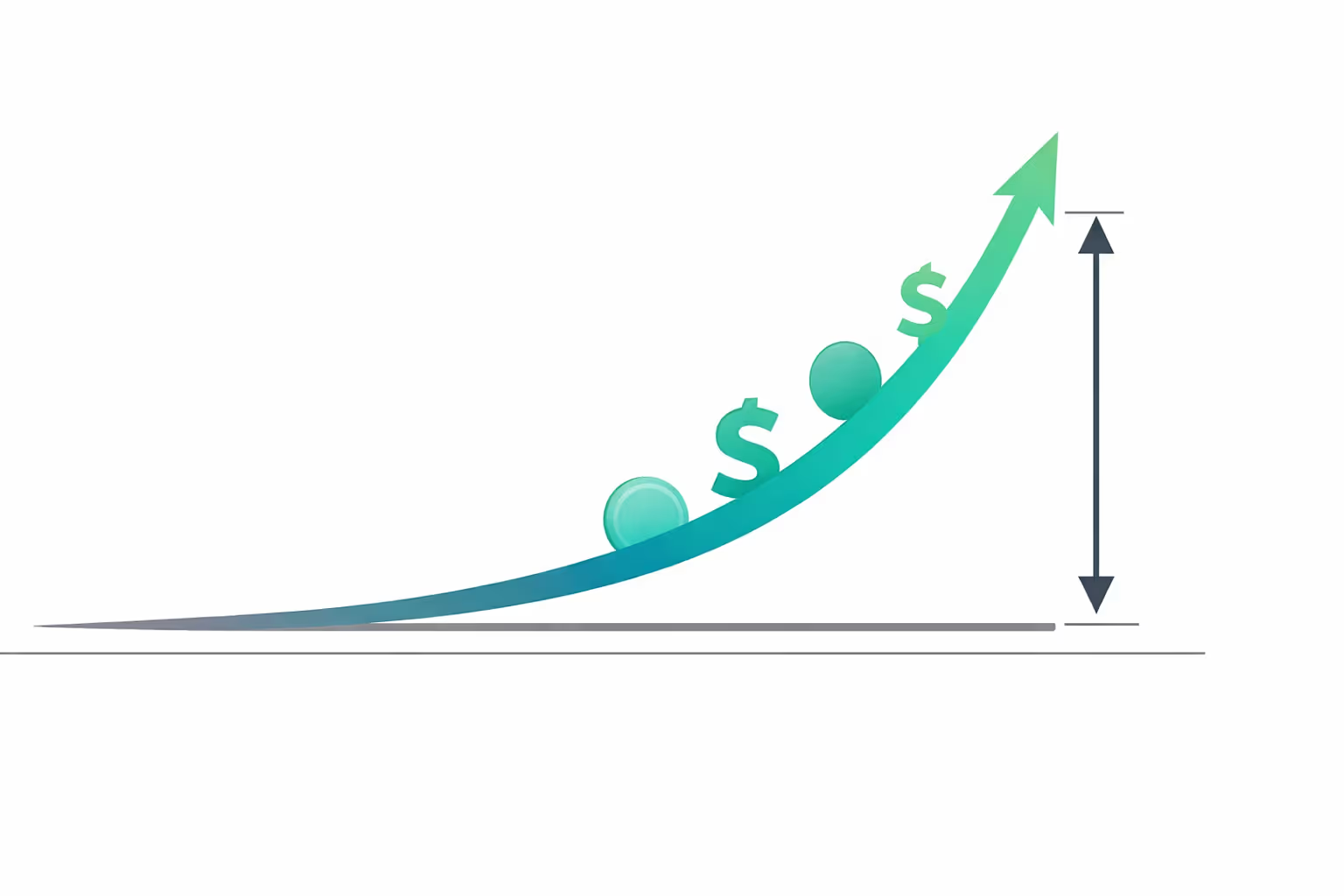
The annual numbers are meaningful, but the real cost emerges over decades. Money in a high-yield savings account earns interest on its interest, year after year; money in checking, earning essentially nothing, misses out on compounding entirely.
Here's what happens to $10,000 over different horizons, assuming monthly compounding at the stated APY:
Read that last row again: keeping $10,000 in checking instead of a high-yield savings account costs over $22,000 in lost growth over 30 years — from a single decision about where to park cash. A household sitting on $20,000 of excess doubles that: more than $45,000 over 30 years, enough for a car, a year of tuition, or a meaningful addition to retirement. This assumes constant rates; if they fluctuate the specifics shift, but the principle holds — near-zero money can't compound, while money earning a real return grows exponentially.
If the math is so clear, why do so many households keep excess cash in checking? The answer is largely psychological.
Most people don't keep extra in checking because they've calculated they need it. They keep it because they're afraid of not having it. The consequences of overdrafting — fees, declined payments, the stress of scrambling — feel immediate and painful. The cost of keeping too much is invisible: you never see the interest you didn't earn.
Even people who suspect they have excess don't know exactly how much they can safely move. Without visibility into upcoming cash flow, they default to caution — and caution means leaving money idle.
Moving money between accounts takes effort, even if it's a few clicks. When the cost of inaction is invisible and the benefit of action feels small, it's easy to do nothing. That's how tens of billions a year slip through the cracks — not in one dramatic mistake, but in millions of small non-decisions.
The standard guidance — keep one to two months of expenses plus a 30% buffer — hands people a static number that's often far higher than they need for day-to-day cash flow. It's well-intentioned but blunt, and it ignores the timing of any individual household's income and expenses.
You've seen how to identify the excess. The remaining question is what to do with extra money in your checking account — and the answer isn't automatically a high-yield savings account.
This article measures the cost of idle cash against a HYSA because it's the clean benchmark: equally safe, equally liquid, paying roughly 4% instead of roughly nothing. But a HYSA isn't always the right destination for your surplus. If you're carrying a credit card at 22%, paying it down beats any savings rate. If you have no cash cushion at all, a starter buffer comes first. The point here is narrower: whatever the destination, money idling in checking at 0.07% is money working for no one.
American households hold roughly $4.5 trillion in checking accounts. Most of it earns almost nothing, while equally safe, equally liquid alternatives pay 4% or more. The result is an invisible drain — tens of billions of dollars a year in interest that's never earned.
At the household level the cost might be a few hundred dollars a year; over decades it compounds into tens of thousands in lost growth. The fix is simple: figure out what you actually need in checking, and move the rest somewhere it earns a return. The barrier isn't complexity — it's visibility. Most people don't know what they can safely move, so they do nothing, and inaction has a cost even when you never see it.
Centinel is built to solve exactly this. It forecasts your checking account balance 2 months forward, shows your projected Account Low, lets you set your Floor, and calculates your Available Cash automatically — no spreadsheets, no guesswork, just clarity about what you can confidently move. If you're ready to stop leaving money on the table, join the waitlist for early access.
This article is for informational purposes and reflects one approach to analyzing household cash management. It is not financial advice. Interest rates, personal circumstances, and financial needs vary. When in doubt, consult a financial professional.
STAY A STEP AHEAD