Budgeting tracks where your money goes. Forecasting tells you whether your checking account survives the month. Here's the difference.
March 3, 2026

Your budget says you can afford rent. It says you earn more than you spend. Your budget is right — and 3 days before your next paycheck, you overdraft anyway.
That isn't a budgeting failure. It's a forecasting failure, and it's the part of personal finance almost no one teaches. A budget allocates your income across categories — rent, groceries, savings — and tells you whether you're living within your means over a month. A checking account cash flow forecast does something different: it projects your balance forward day by day, so you can see what it’ll actually be on the 3rd, the 12th, the 20th. One is about categories and totals. The other is about timing — and timing is what overdrafts people.
This is the difference between the two, why a responsible budget can still leave you short, and why forecasting is the layer most people are missing.
A budget groups your financial life into buckets — housing, transportation, groceries, savings — and checks whether the amounts add up responsibly. It answers real questions: how much am I spending on dining out, am I saving enough, where can I cut back. And it's backward-looking by design — at month's end it shows where your money actually went versus where you meant it to go, and that feedback is what lets you adjust over time.
That's genuinely valuable. Budgeting builds awareness of your habits and keeps your spending intentional. But notice what it operates on: categories and totals. It tells you rent is 30% of your income, that you spent $400 on groceries, that your total expenses came in under your total income. What it never shows you is what happens inside your checking account between paychecks — money arriving and leaving on specific dates.
A forecast ignores categories entirely. It doesn't matter whether $400 left your account for groceries or entertainment — what matters is that $400 left on a specific day, and what your balance was when it did. Forecasting asks a different set of questions: will the money be there when rent hits on the 3rd? What does my balance look like on the 12th, after several bills but before payday? If I move $500 to savings today, can I still cover everything that's coming?
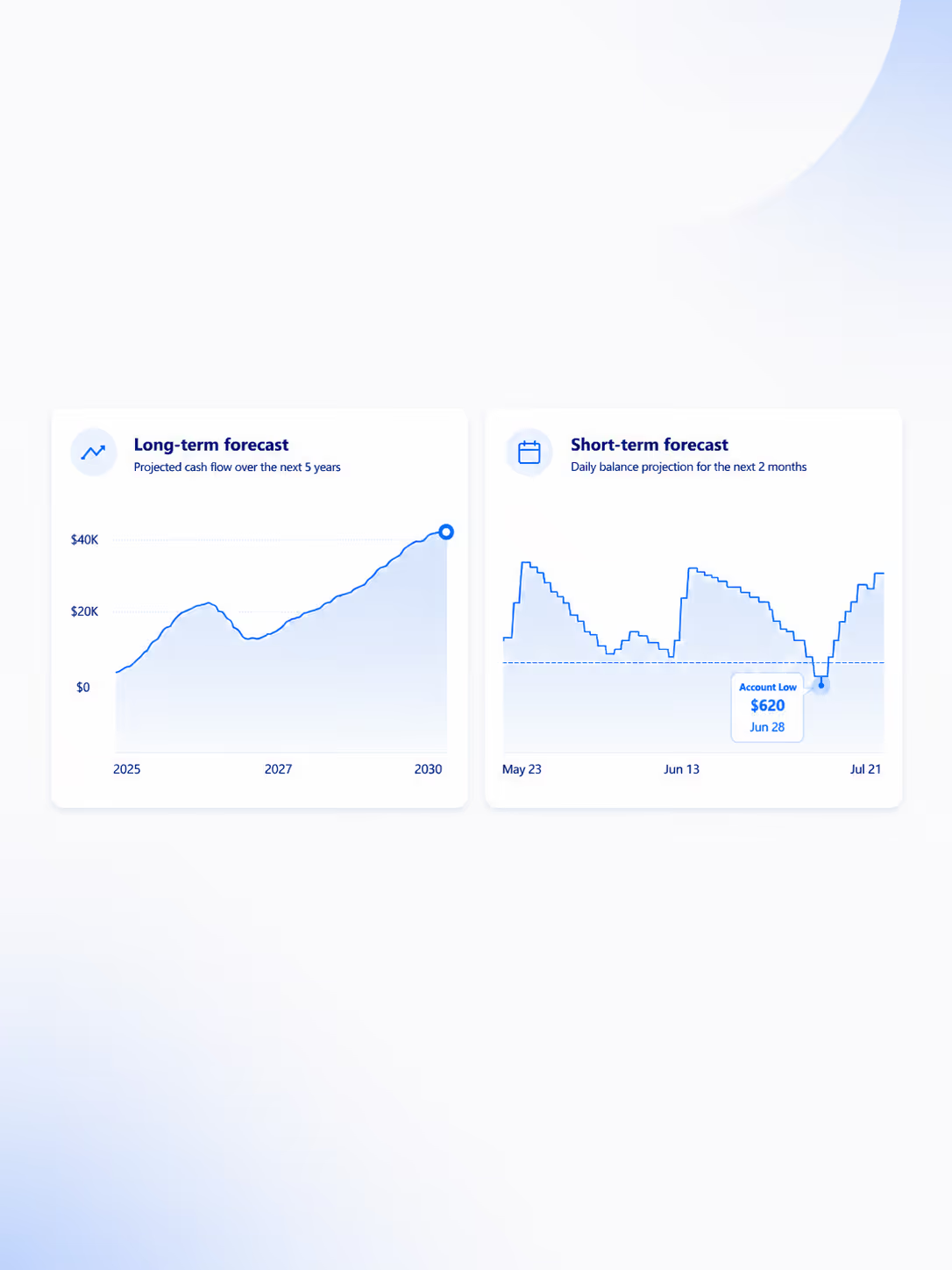
Where a budget looks at money in buckets, a forecast looks at money in motion — when it arrives, when it leaves, and what the balance does in between. It reveals the shape of your cash flow: the peaks after paychecks, the valleys before them, and the specific day your balance sits at its lowest. That's the thing a budget is structurally unable to see — because it's entirely possible to keep a responsible budget and still run aground in your checking account.
Take Tom. He's paid twice a month, $2,400 each time, on the 1st and the 15th. His major bills are rent ($1,500 on the 3rd), a car payment ($400 on the 5th), electric (about $130 on the 10th), and a credit card payment ($650 on the 12th).
Tom's budget looks great. His monthly income is $4,800; those bills total $2,680 — comfortably within his means, with room left for groceries, gas, and savings. By every budgeting measure, he's doing it right.
Now look at what actually happens in his account when he started the month with $150:
On the 12th — three days before his next paycheck — Tom's balance drops to −$130. He overdrafts. Not because he overspent, and not because his budget was wrong, but because four bills landed in the first twelve days of the month while only one paycheck arrived to cover them.
Tom's budget saw the monthly totals, and the totals said he earns more than he spends. A forecast would have walked his account forward day by day and flagged the shortfall on the 12th before it happened — early enough to shift a payment date, delay a transfer, or move money over from savings to bridge the gap. That's the core difference. The budget looked at categories and totals. The forecast looked at the movement of money through the account, and caught a problem the budget was never built to see.
Yes — but they aren't equal, and they aren't interchangeable. A budget is the right tool for questions about habits and allocation: am I saving enough, is my dining-out spending out of control, should I cut subscriptions. Those are category questions, and only a budget answers them. A forecast is the right tool for questions about timing and solvency: will my balance survive until payday, what's left after the next round of bills, can I move money to savings this week without risking an overdraft. Those are account-level questions, and only a forecast answers them.
Most personal finance advice treats budgeting as the foundation and everything else as optional. For anyone who has overdrafted while budgeting responsibly, that framing is backwards. The gap isn't in your budget. It's in the layer underneath it that nobody ever built.
Tom's story wasn't a budgeting failure. His budget was right; the $4,800-in, $2,680-out math worked. What failed was the part of the picture no one had ever shown him — the day-by-day movement of money through his account.
That's what a checking account forecast does. It takes what your bank already knows — your balance, your income, your bills — and tells you what the next two months actually look like: not whether you can afford your life in the abstract, but whether the 12th is going to be a problem. Keep your budget; it's doing real work. But if you've ever been blindsided by your own checking account, the missing piece isn't a better budget. It's a forecast — and that's what Centinel is built to give you.
STAY A STEP AHEAD