Looking for a YNAB alternative? Centinel and YNAB solve different problems — timing vs. budgeting. Here's how they compare and which one fits you.
May 15, 2026

If you're weighing Centinel against YNAB, you're probably in one of two places. Either you're already a YNAB user wondering whether something else would serve you better, or you're shopping for a budgeting app and these two keep coming up together. In both cases the useful thing to know up front is that Centinel and YNAB don't do the same job. They're often compared because both promise to end the same frustration — the scramble between when money arrives and when bills are due — but they end it by solving different problems.
YNAB is a budgeting app: it answers where your money should go. Centinel is a forecasting app: it answers whether the money will be there. One is a question about allocation; the other is a question about timing. Which app is right for you comes down to which of those problems is actually yours — so this comparison is built to help you figure that out, not to crown a winner.
Budgeting and forecasting get lumped together, but they answer different questions.
Budgeting is allocation. It decides how to divide your income across categories — rent, groceries, savings, debt — so your spending matches your priorities. YNAB is a budgeting app, and a rigorous one.
Forecasting is about timing. It projects your actual checking balance forward day by day, so you can see whether the cash will be in the account on the specific day each bill clears. Centinel is a forecasting app.
The gap between them shows up most clearly when your income and your bills run on different schedules. You can have a flawless budget — every dollar assigned, spending well under income — and still not know whether your balance survives the 28th, when rent and a car-insurance bill land in the same week before your next paycheck. The budget says you can afford your life across the month. It can't tell you the balance on a specific Tuesday. That's the clearest line between the two tools.
YNAB is a zero-based budgeting app built around one instruction: give every dollar you currently have a job before you spend it. Money lands in your account, you open the app, and you distribute all of it across categories — rent, groceries, car insurance, savings goals — until nothing is left unassigned. Categories work like digital envelopes; spending depletes them, and overspending one means moving money from another, not from income you haven't received.
A defining rule is that you only budget money you actually have. YNAB refuses to let you allocate future income, on the principle that planning around money you don't yet hold produces a budget that reflects an imagined version of your finances rather than the real one. Sustained over months, that discipline produces a buffer — the point where you're spending money that arrived a full month ago, which YNAB calls living on last month's income.
What YNAB is genuinely good at is changing how you make spending decisions. People who commit to the method often describe it as the first thing that made their spending feel intentional rather than reactive. If your core problem is that money slips away and you don't know where it went, YNAB is built for exactly that, and the methodology has a devoted following for good reason.
The honest trade-offs are three. It takes real time — getting to a full month ahead is a months-to-years project for most people, and longer for anyone starting paycheck to paycheck. It takes ongoing upkeep — maintaining categories is a roughly weekly habit you don't get to stop. And during all of that, it still doesn't answer the timing question: YNAB shows you category balances, not what your checking account balance will be on the 28th.
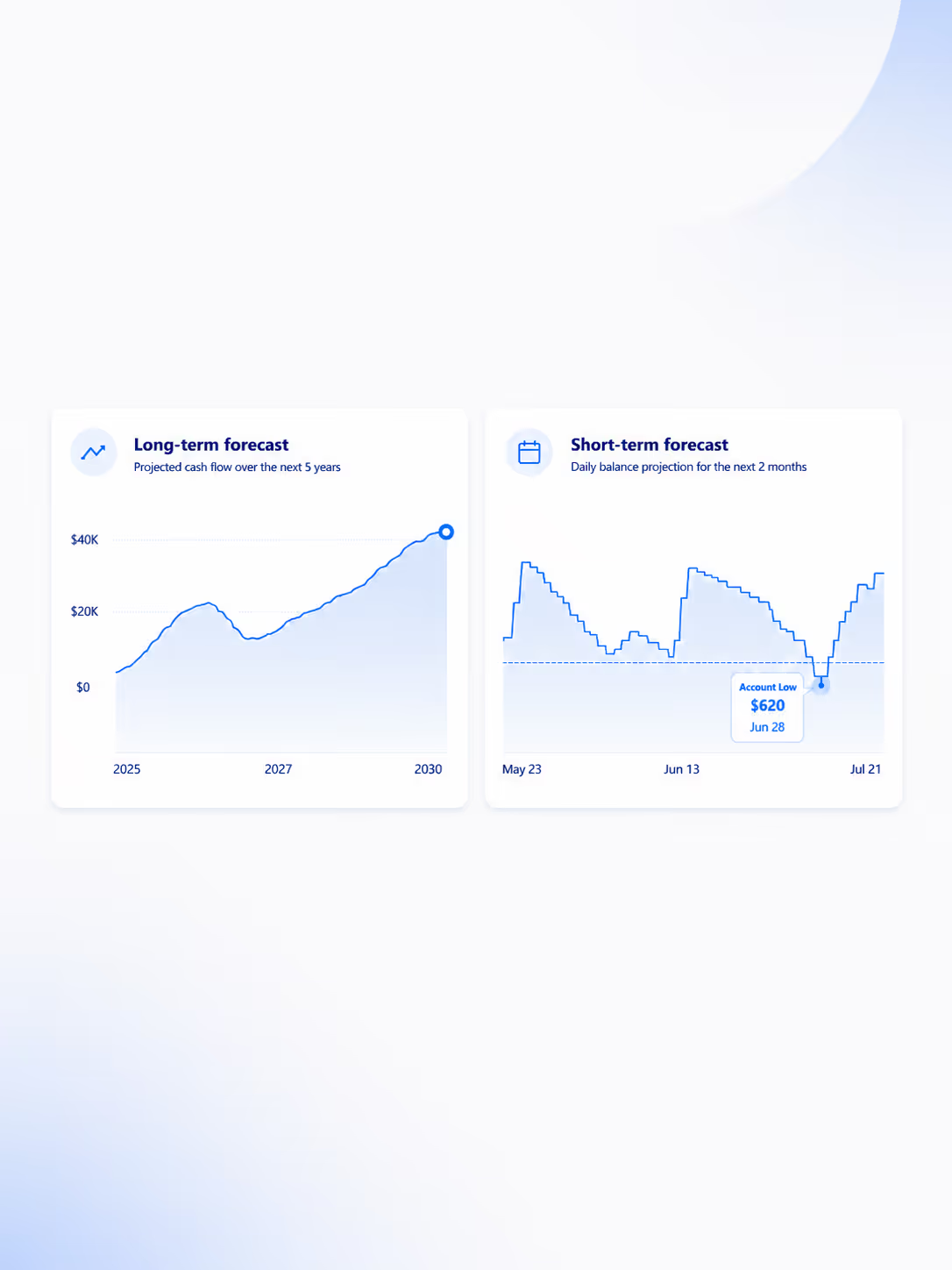
Centinel takes the opposite approach. You connect your checking account, and Centinel automatically detects your recurring income and bills. You confirm what it found and add anything it missed, and from there Centinel's checking account forecast projects your balance forward day by day for the next two months — showing when each paycheck lifts it, when each bill draws it down, and what the lowest point is across the window.
The forecast doesn't ask how much you spend on groceries. It answers one question — given your current balance and what's scheduled, where will you actually be on any future day? — and that single answer does two jobs.
The first is safety. You see a tight spot weeks before it arrives, while you still have room to act: shift a discretionary expense, move money in, ask a creditor to adjust a date. A shortfall you can see coming is a problem you can fix. The same shortfall discovered the day it lands is an overdraft fee.
The second is optimization. The forecast separates the part of your balance that's genuinely free from the part already committed to bills that haven't posted yet — the foundation for knowing what's actually safe to spend or move out of checking into something higher-yielding.
Centinel works on day one, without requiring you to change your financial position first — it changes what you can see, not what you have, so it's useful even if you're living paycheck to paycheck right now.
The honest trade-off is the mirror image of YNAB's. A forecast reveals your position; it doesn't restructure your spending. If your real problem is that you're spending more than you earn, the forecast will show you the consequences clearly but won't change the behavior on its own. For someone whose primary need is spending discipline rather than timing visibility, a forecast alone won't be enough.
YNAB and Centinel both end the scramble between paychecks and bills, but they differ on how — and the cleanest way to see it is to take Centinel's two jobs, safety and optimization, and set each against YNAB's approach.
On safety, the difference is timing. YNAB ends the scramble by building a buffer until you're a month ahead, at which point no bill depends on any particular paycheck. That works, but it's a months-to-years project. Centinel ends the same scramble by making the shortfall visible weeks ahead, starting the day you connect your account. In other words, protection eventually versus foresight today.
On optimization, the difference is philosophy, and it runs deeper. YNAB's endgame keeps a month of expenses sitting in your checking account; that's what "live on last month's income" means, and it's what makes timing irrelevant. It also means a month of expenses parked where it typically earns nothing. Centinel's endgame is the opposite. Because the forecast shows the lowest point your balance is expected to reach, you can hold only the minimum you actually need in your checking account and treat everything above it as surplus — money the forecast shows isn't claimed by an upcoming bill — and route it to high-interest debt or savings that earn a return. YNAB pads your checking account until timing stops mattering; Centinel makes timing visible enough that you can run checking lean and put the rest to work.
Price is where a lot of people start, so it's worth being direct about it.
YNAB costs $14.99 per month, or $109 per year, after a 34-day free trial. It's among the more expensive budgeting apps, and the annual price has climbed over the years — from $50 a decade ago to $109 today.
Centinel costs $7.99 per month, or $69.99 per year, after a 30-day free trial with no credit card required — roughly half YNAB's annual cost.
That gap is real, but price alone is a weak reason to switch, because you'd be comparing two different tools. If you want zero-based budgeting and YNAB's price is the only thing holding you back, the honest move is to look at cheaper budgeting apps, not at Centinel, which doesn't do envelope budgeting. Centinel is the better value only if what you actually need is the timing visibility YNAB doesn't provide.
Choose YNAB if your underlying problem is how you make spending decisions. If money feels like it happens to you, if you want every dollar to be a conscious choice, and you're willing to spend time each week maintaining categories, YNAB's method is built for that and will get you to a buffer if you stick with it.
Choose Centinel if your underlying problem is the gap between when money arrives and when bills are due — especially if you're paid weekly, biweekly, or irregularly. If your spending is broadly under control and what you actually lack is the ability to see whether you're safe and what's genuinely free to move, a forecast gives you that immediately, without a year of buffer-building first.
Can you use both? Yes, and for some people that's the cleanest setup, because the two tools don't conflict. Let YNAB answer "where should this dollar go?" and let Centinel answer "will my checking account hold on each date?"
YNAB and Centinel both respond to the gap between when money arrives and when bills are due, but they solve different problems on the way there. YNAB restructures how you allocate money and, over time, builds a cushion that makes timing irrelevant. Centinel makes the timing visible now, so you can navigate it immediately and keep your checking account lean. Pick the tool that matches the problem you actually have — and if that problem is knowing whether your checking account will hold over the next two months, Centinel is the solution.
It depends on why you're leaving. If you want zero-based budgeting in a cheaper or simpler package, Centinel isn't a like-for-like replacement — it doesn't do envelope budgeting. If you're leaving because what you really needed was to see your checking balance ahead of time and YNAB doesn't forecast, then yes, Centinel is the alternative that fits your problem.
No, by design. YNAB declines to project money you haven't received yet, on the grounds that planning around future income produces an unrealistic budget. It shows category balances and historical reports, but not your projected checking balance on a future date. Forecasting that forward is precisely what Centinel does.
Yes. They don't conflict at the data level. The natural division is YNAB for monthly allocation and Centinel for day-to-day balance forecasting.
Both handle it differently. YNAB waits — you only assign money once it actually arrives, which protects you from planning around income that doesn't show. Centinel forecasts with estimates and adjusts as deposits land. If you'd rather plan from what's confirmed, YNAB's rule is a feature; if you want visibility into the likely shape of the next two months, Centinel's forecast fits better.
YNAB is $14.99 per month or $109 per year after a 34-day free trial. Centinel is $7.99 per month or $69.99 per year after a 30-day free trial with no credit card required.
STAY A STEP AHEAD