Both apps produce a Safe to Spend number for your checking account. Only one is reliable without checking the math yourself. Here's the architectural reason.
May 11, 2026

Rocket Money has a Safe to Spend feature. Centinel has a Safe to Spend equivalent called 'Available.' Both target the same underlying question: what can you spend in your checking account right now without putting the account at risk? Both answer it with a single number. And both update as transactions post.
Beneath the surface, the two products take different approaches to producing that number. Rocket Money's Safe to Spend is a fast, low-friction calculation that stops at the next paycheck and leaves the user to handle whatever falls outside its horizon. Centinel's Available is a 2-month forecast that builds in a user-defined safety margin and surfaces the lowest projected point in the window. The numbers can diverge significantly, and the divergence isn't a bug in either app — it's the predictable consequence of two different architectural choices. One of those choices produces a number the user can act on without doing additional math themselves; the other doesn't.
Outside Safe to Spend, the two products barely overlap. Rocket Money does subscription cancellation, bill negotiation, credit monitoring, and budgeting — work Centinel doesn't try to replicate. Centinel forecasts your checking-account balance 2 months forward using a deterministic event ledger — work Rocket Money isn't built for. The rest of this article focuses on where they overlap, because that's where the choice between them actually matters.
Disclosure: We make Centinel, so we have a stake in this comparison. We've worked to represent each tool fairly and to base the analysis on what the product actually does, including direct documentation from Rocket Money's own help center.
Rocket Money is built around helping users find and cancel unwanted subscriptions, negotiate recurring bills, monitor credit scores, and budget. The headline value proposition for most of its ten million-plus members is "we'll find subscriptions you forgot about and cancel them for you." Bill negotiation, in which Rocket Money negotiates lower rates with cable, internet, and phone providers in exchange for a 35 to 60 percent cut of first-year savings, is the second major draw.
Safe to Spend lives inside what Rocket Money calls Payday View — a Premium-only feature that surfaces a single number the user can spend before their next paycheck without running into trouble. The feature is an extension of Rocket Money's existing recurring-charge detection infrastructure. The same machinery that identifies subscriptions to cancel also identifies upcoming bills to subtract from your cash. Safe to Spend is the output, but it sits on top of an app architected for a different primary purpose.
For users whose biggest financial pain is subscription creep or wanting bills negotiated down, Rocket Money offers real value Centinel doesn't try to replicate.
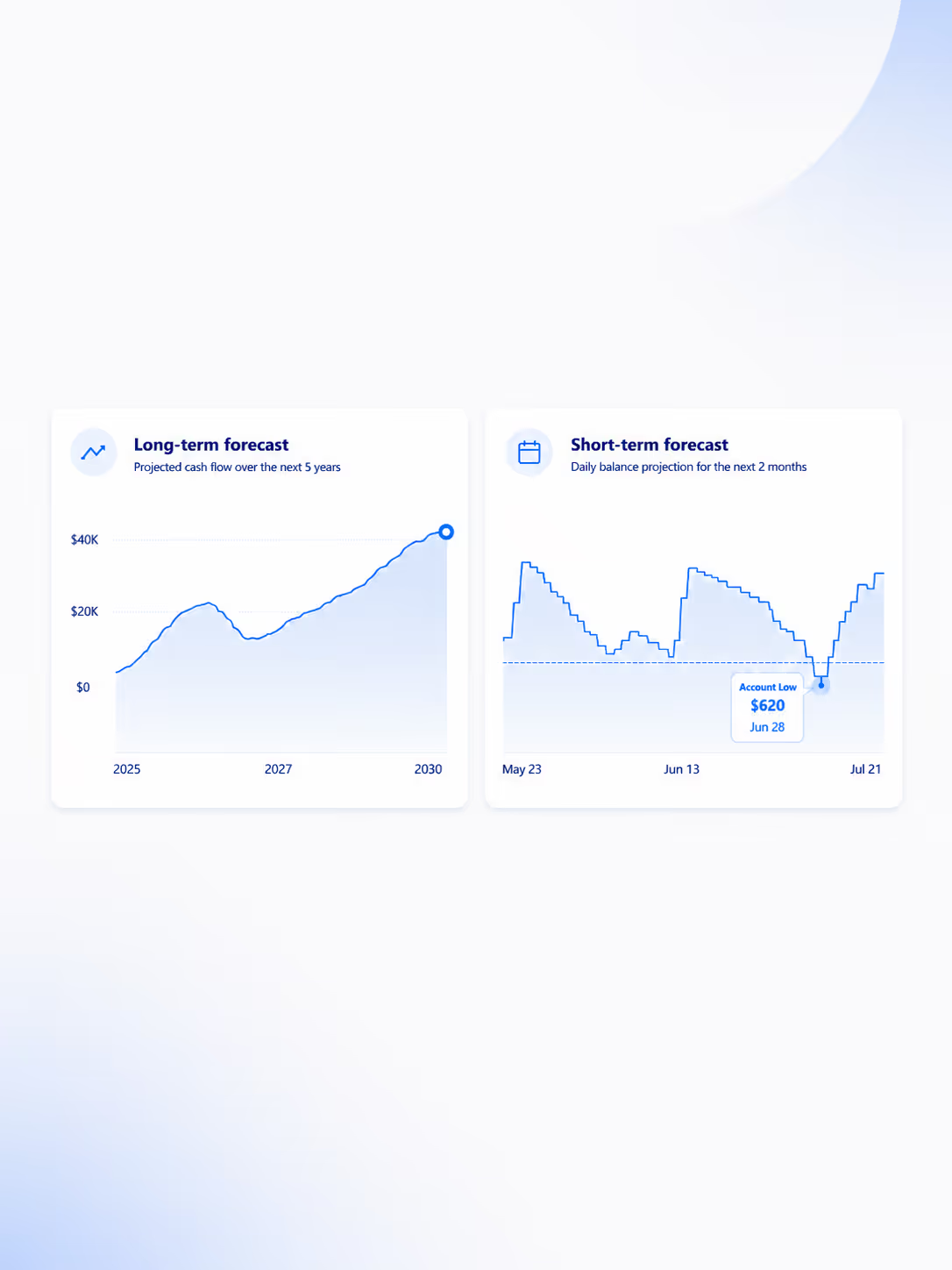
Centinel does one thing: it produces a day-by-day forecast of your checking account over the next 2 months and tells you whether the account is safe or at-risk and how much money you can confidently move out of it. The forecast is the product. Every feature — the ledger, calendar, and chart views, the reconciliation system, the notification architecture — exists to keep that forecast accurate and surface what it reveals. Centinel's safe-to-spend metric, called Available, is surfaced directly on the home page when you open the app.
Both apps produce a single number representing what's safe to spend in your checking account. The architectures behind those numbers differ in three meaningful ways: how far ahead the calculation looks (Rocket Money stops at the next paycheck; Centinel projects two months), what inputs drive it (Rocket Money detects patterns; Centinel uses a user-maintained event ledger), and whether the number reflects a safety margin or just the edge of zero (Rocket Money has no margin concept; Centinel subtracts a user-defined Floor). The differences compound, and they show up most clearly in scenarios that aren't unusual.
Rocket Money's formula is straightforward: current cash across linked accounts, minus the upcoming bills, and credit card payments detected to hit before the user's next paycheck. The math is single-horizon and arithmetic.
The inputs come from automatic detection. Rocket Money looks at transaction history, identifies recurring patterns, and projects each one forward. A paycheck is detected as a recurring deposit with a consistent description and cadence; a bill is detected as a recurring debit with similar consistency. For Payday View to activate at all, Rocket Money's documentation says the system needs to see at least three paychecks with consistent descriptions and cadences from a connected account. Variable income (e.g., commission, freelance, side work) and manual income entry (e.g., the user cannot tell the system 'I expect a $3,000 deposit on Friday' even if they know it's coming) are both explicitly unsupported per Rocket Money's own Payday View documentation.
The horizon is the most consequential architectural choice. Rocket Money's Safe to Spend only looks at bills landing between now and the next detected paycheck. For a biweekly W-2 earner, that's at most two weeks of obligations; for a weekly earner, it's a few days. Bills falling just past the next paycheck are invisible to the calculation, even when they're imminent and known.
There is also no concept of a safety margin in Rocket Money's Safe to Spend. The number it shows you is what would zero out your account before next payday — the absolute edge, not a buffer-protected number. The user has to apply the cushion themselves: "Okay, the app says I have $400 safe to spend, but I want to keep $500 in my account, so really I have… well, let me think about this." The system computes a number; the user does the rest. This isn't a small omission. The Floor is what separates a number you can act on from a number you have to revise in your head before acting on it.
The shorthand: Rocket Money's Safe to Spend is a fast, automatic read on detected patterns, scoped to the period before the next paycheck, with no safety margin built in. Where the data is incomplete or the horizon is too short or the user wants a cushion, the user picks up the slack.
Centinel's safe-to-spend metric, called Available, equals the lowest projected balance in the next two months (the Account Low) minus a user-defined safety threshold (the Floor). If your Account Low is $1,800 and your Floor is $1,000, your Available is $800 — that's what's safe to spend without your balance dipping below your comfort zone at any point in the next 2 months.
The inputs are user-declared events. During onboarding, Centinel scans transaction history and identifies likely recurring transactions, but the user reviews and confirms them — converting them into saved events with explicit dates, amounts, and frequencies. Users can also add events the system didn't detect, including one-time future expenses (a vet bill next Thursday, a tax bill due in two months) and income that doesn't fit a regular pattern. Each event carries cadence metadata: a paycheck is "biweekly on Fridays starting March 7"; rent is "monthly on the 1st"; quarterly insurance is "quarterly starting in February." The forecast walks through the next two months and projects each event correctly into the period it actually falls in.
The horizon is 2 months. 2 months is long enough to surface bills that are coming but not yet imminent, but also short enough that the projection remains reliable — forecast accuracy degrades with distance, and at horizons longer than two or three months a deterministic projection runs into too many unknowns.
The Floor is a first-class concept. The user picks a number — say $1,000, or $500, or $2,000, depending on their risk tolerance — and Centinel computes Available as Account Low minus Floor. The Floor is how Centinel knows what counts as safe: the question isn't "will my balance go below $0," it's "will my balance stay above the cushion I want to keep."
Reconciliation runs continuously. Every saved event has a state: projected, matched to a real transaction, or flagged for review. When a transaction posts, Centinel either matches it automatically, surfaces it for confirmation, or flags it as unexpected. Discrepancies in both directions are surfaced, so when a projected event doesn't post on time or an unexpected transaction posts, the user resolves it explicitly rather than letting the forecast drift silently.
The clearest way to see the difference between the two calculations is a concrete scenario.
Imagine the following situation. Today is May 1. Your checking balance is $3,000. Your $2,500 paycheck arrives every other Friday; the next one lands May 8. Rent of $2,500 is due today — before the next paycheck. Your credit card payment of $2,700, the largest single bill of the cycle, posts May 10 — two days after the paycheck. Your Floor is $200.
Here's how the forecast looks in Centinel's ledger:
The Account Low is $300, hit on May 10 after the credit card payment posts.
The two apps now compute Safe to Spend differently:
Rocket Money Safe to Spend: Balance ($3,000) − Bills before Next Paycheck ($2,500) = $500
Centinel Safe to Spend (Available): Account Low ($300) − Floor ($200) = $100
The two numbers diverge by $400. The difference is architectural. Rocket Money's horizon ends at the May 8 paycheck, so the $2,700 credit card payment two days later sits entirely outside the calculation. Rocket Money sees $3,000 of cash and $2,500 of rent before the next paycheck, concludes you have $500 to spare, and shows you that number. Centinel walks the entire two-month forecast, finds the worst point in the cycle (the post-credit-card balance of $300), subtracts your $200 Floor, and tells you that $100 is what's actually safe to deploy without crossing your cushion.
Here's what happens when the user acts on each number:
The user who follows Rocket Money's number overdrafts. The user who follows Centinel's number lands exactly at their Floor.
The reason Rocket Money's $500 looks reasonable is that it's correct on its own terms. Before the next paycheck, $500 really is what's left after the $2,500 of imminent obligations. But "Safe to Spend before payday" is a fundamentally different question than "Safe to Spend, period," and most users hear the latter when they read the former. When a major bill lands just past the next paycheck, Rocket Money's horizon hides it.
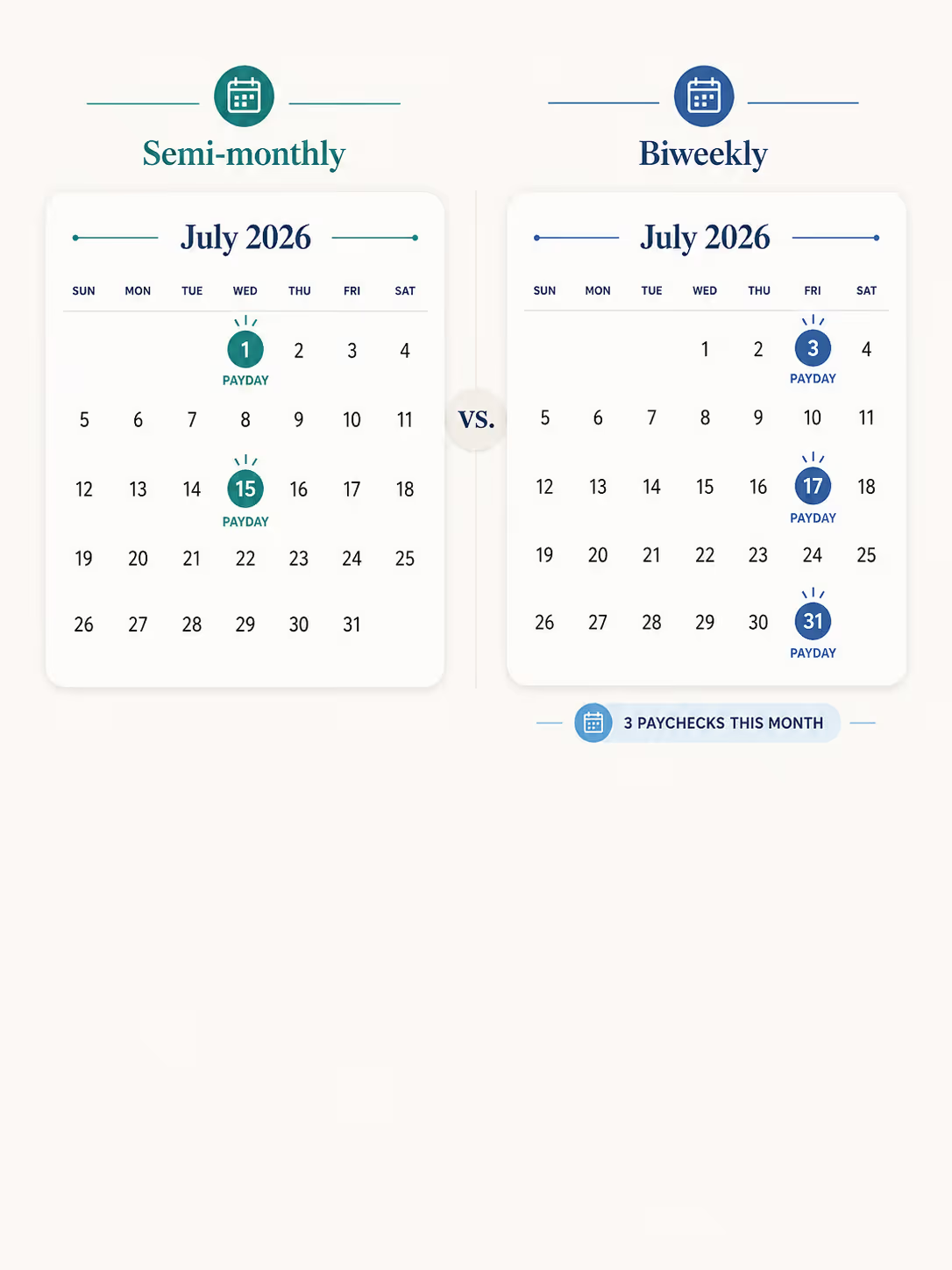
This isn't an edge case. Biweekly paydays and monthly bills don't share a calendar, so some bills inevitably land just after payday rather than just before — and whenever that happens, Rocket Money's number misleads.
The two products are easy to choose between because they don't really overlap on what they're best at.
Choose Rocket Money if your primary financial pain is subscription creep, bills you want negotiated down, budgeting, or a desire for an automated "find money I'm wasting" tool. Centinel doesn't compete on those fronts. Rocket Money's strength lies in the broader subscription management ecosystem — finding charges you've forgotten about, canceling them on your behalf, negotiating ongoing bills — and that's a genuinely valuable category of work that Centinel doesn't try to replicate. If Safe to Spend is something you'd glance at occasionally as one feature among many, the limitations explored here may not bother you in practice.
Choose Centinel if your primary financial pain is uncertainty about your checking account — wondering whether you can afford an upcoming purchase, hesitating to move money to savings because you're not sure what's safe, getting surprised by overdrafts or low balances. Centinel is built end-to-end for that question, with a forecast horizon, reconciliation system, and Floor concept all designed around producing a number you can act on. Rocket Money's Safe to Spend isn't a substitute for this; the architectural gaps mean the number can mislead in exactly the situations where you most need it not to.
Centinel is currently in pre-launch. If you want forecasting that tells you what's actually safe to spend in your checking account, join the waitlist.
Yes. Rocket Money's Safe to Spend is a Premium-only feature within Payday View, available in the iOS and Android apps. It displays a single number representing current cash across linked accounts minus the upcoming bills, subscriptions, and credit card payments detected to hit before the user's next paycheck. It requires Rocket Money to detect at least three consistent paychecks before activating, doesn't support manual income entry, and uses a "before next payday" horizon that excludes any bills falling after the next paycheck date.
Centinel computes Safe to Spend (called ‘Available’) using a deterministic two-month day-by-day forecast of the user's checking account. The forecast is built from a ledger of cash flow events (each carrying real cadence metadata), reconciled continuously against actual transactions. The Account Low across the two-month window minus a user-defined Floor produces Available. Rocket Money's calculation is a simpler arithmetic on detected patterns, scoped to the period before the next paycheck, with no concept of a Floor.
The most common reason is that Rocket Money's horizon ends at the next paycheck. If a major bill — typically rent, a mortgage, or a credit card payment — falls just after the next paycheck date, that bill isn't subtracted from Safe to Spend, even though it's imminent. The user sees a number that reflects only the bills before payday, not the bills coming right after.
The Floor is a user-defined safety threshold — the minimum balance you want to keep in your checking account at all times. Centinel uses your Floor to compute Available: the number is Account Low minus Floor, where Account Low is the lowest projected balance over the next two months. A higher Floor produces a lower Available (more cash held back as cushion); a lower Floor produces a higher Available (more cash deployable).
Not for everything. Centinel doesn't do subscription cancellation, bill negotiation, credit monitoring, net worth tracking, or budgeting. If those are why you use Rocket Money, Centinel isn't a substitute. Centinel only replaces Rocket Money's Safe to Spend feature, and only for users whose primary need is reliable visibility into their checking account.
Yes. They solve genuinely different problems. Rocket Money handles subscription discovery, bill negotiation, and broader recurring-charge management. Centinel handles checking account cash flow forecasting.
Rocket Money's Payday View doesn't support variable income — its documentation explicitly states that income with inconsistent amounts or dates can't be tracked, and there's no manual income entry. Users with commission, freelance, or other irregular pay either can't activate Payday View at all or get a calculation that uses an unrepresentative detected amount. Centinel allows the user to add and edit income events directly, including one-time deposits and irregular schedules.
Rocket Money offers a free tier with limited features and a Premium tier priced on a "pay what you think is fair" model, currently $7 to $14 per month. Safe to Spend is a Premium-only feature. Bill negotiation is a separate fee, charging 35 to 60 percent of first-year savings as a success fee.
Centinel offers a free tier that supports manual entry of recurring transactions. Premium tier pricing, which includes bank connectivity, automated syncing, transaction matching, and push notifications, will be $7.99/month or $69.99/year, and will include a 30-day free trial.
Centinel is currently iOS-only. Android is on the roadmap but not yet available.
STAY A STEP AHEAD